NOTE: periodic updates follow the essay. These updates are short-term in nature; this essay takes a longer view toward a different end-state, if ever viable, now deferred by this current conflict.
B.L.U.F. (bottom-line, up-front): The world in general as well as Israël and Palestine in particular need to undertake a BIG RE-THINK that is long overdue.
THINKING POINTs . . .
- Like it or not, the world owes a Jewish right-of-return after eliminationist anti-Semitism culminated in the Holocaust.
- Like it or not, the descendants of Palestineans internally displaced three generations ago have a right-of-return.
- The two-state solution
is a not-so-polite fiction.
- Hamas proved that eliminationist anti-Semitism still exists.
- The agents-of-change will not be politicians, soldiers, or diplomats on either side but grieving mothers on both.
SEVERAL DATA to keep in mind:
- 2.1 million people in Gaza;
- 3.2 million on the West Bank;
- 9.1 million in Israël;
- estimated 40,000 people in Hamas militia;
- approximately
650,000 members in the Israeli Defence Forces; as
well as,
- Gaza territory
of 360 square kilometers, or 140 square miles; (i.e., equivalent to the 73rd largest city in the United States or, at best, the 251st globally).
· Please note: the scope of this essay is confined to Israël and Gaza; other stake-holders (e.g., Hizbullah, Lebanon. The United States, Syria, The European Union, Jordan et al.) lie beyond the scope of this brief essay.
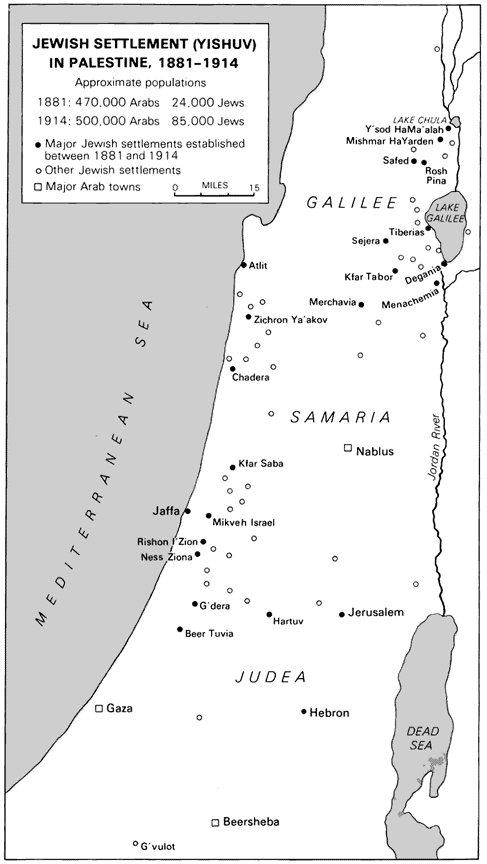
Jewish right-of-return. For those of us who believe the Jews have earned a homeland through their suffering, this point is non-negotiable. The historical right of return arguably dates from the persecution, forced dispersion, and exile of the Jews by the Romans after the Jewish revolt of A.D. 70. Though The Peel Commission Report of 1937 implied the movement of Arabs to make way for Jews, in the sixty-six years preceding Israël’s independence, less than 700,000 Jews had migrated to Palestine, with a 50% influx in 1947 alone, since the emergence of Zionism in the 1880s. At the time of Israeli independence, Jews represented under a third of the population of Palestine. Jewish émigrés to Palestine constituted only some 6% of international Jewry.
One question that made Palestine attractive for liberated Jews, and to Allied
Powers, was the massive problem, at the end of World War II, of many millions of displaced refugees in Europe, of which at least 250,000
were Jews with most refusing to return to Eastern Europe. The Holocaust was
only the latest – and by far the worst – of brutal treatment of Jewish
minorities throughout Europe, though far more so in Germany and Eastern
Europe. The idea of a safe-haven became compelling to many who feared that anti-Semitic oppression might pause after 1945 but would not end in Europe and elsewhere.
Palestinean
right-of-return. The nakba
(i.e., the ‘catastrophe’) totalled up to a million Palestineans internally displaced
in the late 1940s and 1950s to make way for the Jewish state. It is unclear what portion of these displaced
natives of Palestine left
their homes voluntarily, seeking to avoid the cross-fire of an imminent war.
The narrative implies that these civilians intended to return home after the
Arab nations had defeated Israel, an outcome which, thankfully, never came.
What remains clear – whether leaving their homes voluntarily or under existential
duress from Jewish fighters (per an alternate narrative) – is that all of
these Palestineans were internally
displaced.
Many or most
of these people had no chance to return to their homes owing to the absentee property law of 1950 under which the Israeli government
appropriated homes deemed abandoned. Again, it is not clear what percentage of
these 'abandoned' homes had belonged to Palestineans, but that percentage is likely to be high. Evidently, the tragedy of such expropriation has continued to the present day, likely to enable the
establishment of settlements within territories occupied by Israël, including population centers (as I saw in Hebron), occupied since 1967. These laws and the displacements in
the late 1940s and early 1950s argue in favor of a right of return, likely to
be managed through compensation.
The
two-state solution. Partitions usually do not end well as illustrated by India, Viêt Nam, South
Africa, Germany, the Roman Empire, Syria et al. Two exceptions may be Korea by
force of arms and Ireland with still maturing results as discussed below. Palestine most certainly
is not a poster-child for the wonders of partition. The two-state solution emerged
during a time when partition seemed like an ideal solution for contentious ethno-sectarian divisions threatening to break out into violence within the same historical land-mass.
In the case of India, partition extricated the British from a difficult situation. Mahatma Gandhi, like many other Hindus and Muslims, opposed partition, implying (as I have read years ago but can not document it now) that Hindus and Muslims needed to stay put and to work something out. So, too, do the Muslims and Jews in Israël, as have the Catholics and Protestants in Northern Ireland.

Source: "Times of Israël"; 08oct17; Women Wage Peace March of 20-30,000 Jewish and Palestinean participants
That is
where the BIG RE-THINK needs to focus: on a federated government with an equal
number of provinces with Islam as the territorial religion and with Judaism as
the territorial faith. The territories can aid the minorities of Muslims or
Jews in other territories for education, etc. How Christians would have their
rights protected would come through a specific protection guaranteed by the
separation of church and state at the national level. Is this a pipe-dream?
Yes. Is it doable? Yes, if one looks at historical population patterns over
time (i.e., late 1800s, 1920s, 1940s, and today) in Palestine and greater Israël.
Additionally,
especially from the Arab view, the proposed partition embodied in the
two-state solution is hardly a true partition. There are deal breakers on each side. For
the Jews, one need only look at a map of the 1949 borders, erased by the
six-day triumph of Israël in 1967. Following this evil perpetrated by Hamas on 07oct23, one readily sees that Israël will never give up the occupied
territories since the pre-1967 borders would be very difficult to defend. Likewise, the rump
of desert territory allocated to the Palestinean state is economically
unsustainable as demonstrated by the skewed access to water in favor of the Israeli settlements in the West Bank. Structural difficulties
imposed by the Israeli government are creating food insecurity for
Palestineans.
Eliminationist anti-Semitism within Hamas. In his insightful book, Hitler’s Willing Executioners, Dr Daniel Jonah Goldhagen devoted the first hundred pages or so to the rise of eliminationist anti-Semitism in Germany starting with the long-time prejudice of the late nineteenth century, coming to fruition in the Holocaust. Dr Goldhagen also documented how a populace can become complicit in the crimes of the state. Hamas may be providing a latter-day example of Dr Goldhagen’s thesis.
(Please note that the book’s reception and ensuing debate in Germany indicates just how remarkable Germany’s transformation into a great-power democracy has been. In fact, I only came across the book upon the recommendation of German a banker, whom I was courting, in New York City.)
For those of
us devoted to Israël, Hamas proved what many of us have suspected all along:
were the power dynamics reversed with Palestineans and their Arab neighbors
holding a predominance of military power, the Jewish safe-haven would have been
wiped out two or three generations ago. Sadly, polls are indicating that Gazans
may not support Hamas owing more to what the organization has failed to deliver to them than its barbarity.
The peace
movement. This section is largely speculative and draws
on my field work in Iraq and Afghanistan, as confirmed by my teaching
experience in Tunisia.
- If you want to want to change a policy, argue with the men.
- If you want to change a culture, work with the women.
One current example of this Lysistrata’s revenge is the quiet, underlying role of women in the peace process of Northern Ireland in the years preceding the 1998 ‘Good Friday Agreement’. One can bet that Protestant and Catholic mothers who buried sons after they had bled out in the same color catalyzed much of the movement in the 1990s. Women Wage Peace is a movement among Jewish and Arab mothers in Israël seeking to modify and mollify the long-term policies of the Israeli government and the consequent Islamic terrorism (as the warfare of the weak).
Of course,
there was likely a near-universal rejection of the terrorism espoused by the Irish
Republican Army (the I.R.A.) and the Unionists as portrayed in Kenneth Branagh’s sublime film about Belfast at the beginning of ‘the
troubles’. As time went on and residents acclimated themselves to the street
violence, however, more people either joined militias or quietly condoned the
depredations perpetrated by them. The good news is that the Givat Haviva Foundation to promote amity among Arabs and Jews has operated across Israël and Palestine since the 1940s.
In short: peace has a base on which to build. Unfortunately, it is difficult to gauge
whether the ‘Gazan Street’ has rejected violence, though a few voices are emerging in favor of peace through sites like 'Whispered in Gaza'; (thank you, Mr David Ignatius of The Washington Post.) Looking at Palestine as a
fractured whole and Northern Ireland, such peace movements date back to 1993 in
Israël and the late 1960s in Ireland. So, what took so long?
Two things, really; pure speculation here. Cultures and the prejudices they enable are slow to change, perhaps two generations as implied by the Exodus of Jews from Egypt. One can argue, as did a brilliant colleague of mine, that Moses marched the Hebrews through the desert for forty years – or two generations – to wean them off the culture of lentils and servitude then to supplant it with one of assertiveness and entreprise.
The other factor is the hidden agendas of terror groups like
the I.R.A., Hamas, or Hizbullah. These groups are freedom fighters, yes. But
what happens when peace does come? They are obsolesced and the terrorists populating them lose their power over, and wealth from, the very people they
are supposedly seeking to liberate.
UPDATES
============================
Update 09jan24: I watch the news reports and shudder at the television footage of Gazans openly celebrating the atrocities in the streets as kidnapped innocents are paraded by them. Those images deepen my conviction that an attack on the scale of that undertaken by Hamas not only had the support of its gangster régime, but also the permission (or acquiescence) of the surrounding populace. That so many people refused to leave in the time following the Israeli government's warning to move south begs the question of a possible willingness to intersperse the murderers among them.
These are profoundly disturbing possibilities. That does not excuse so many deaths of people otherwise innocent who are closeted away in the Gaza strip. The Israeli Defence Force is conducting a conventional war in what is really a very contentious urban counter-insurgency. The delivery of five hundred pound bombs by the United States of America is also disturbing; yes, they are intended to collapse the tunnels used to pernicious effect by Hamas, but ¿doing so in a densely populated city-scape of which, at most, two per cent of the citizens are active terrorists? These words express grief, not judgement.
============================
UPDATE: 07mar24 (five months on): a response filed today with a former State Department colleague -- not a close working colleague -- who is leading the charge against the U.S. government's enabling of Israël's campaign against the Palestineans in Gaza.
Please note: I have expanded or added text previously cut out owing constraints imposed by the social medium for responses to a post; these changes are in green-font, with the exception of the paragraph break and see-no-evil emoji.
-----
B.L.U.F. (bottom-line, up-front): keep up the good work, good man.
✌
Though I am devoted to Israël and Judaism, I have to heed the call of justice. Israël has crossed two invisible lines:
> from collateral damage to collateral carnage; and,
> from collateral carnage to war crimes.
At the very least, Netanyahu is guilty of war crimes and President Biden et al. are, regrettably, complicit. The International Court of Justice had given Israël and the Biden Admin. fair warning.
😰
First, I raised a question: ¿how many civilian deaths is too many?
¿A legitimate question at the time? NO. Simply temporizing in the hope that Israël would abate her bloody retribution.
😳
Then, ¿what if this blood-drunk orgy by Hamas had occurred in the U.S. (i.e., 50,000 innocents killed, etc.)? That, too, was calculated to evade an increasingly restive conscience. Were I to scale up Israël's response, there would be one million, two hundred thousand Palestineans dead. That number renders the evasion ridiculous. [Added 23mar24]
🙈
After all, I had heard, just after 07oct23, a senior Israeli government spokesman say that Israël would cut off all water, electricity, food. In the back of my mind, I was alarmed. That that alarm did not turn into a deafening siren is on me, at least in retrospect.
🤥
Lastly, ¿was the Gaza Street not permissive, even complicit, in the massacre? YES, it was, most assurèdly. That taint became irrelevant after, at most, the 1201st civilian death, or 20-25,000 deaths of innocents ago.