Life of an average joe

These essays cover a tour in Afghanistan for the first seventeen letters home. For an overview of that tour, and thoughts on Iraq, essays #1, #2 and #17 should suffice. Staring with the eighteenth letter, I begin to recount -- hopefully in five hundred words -- some daily aspects of life in Mexico with the Peace Corps.


Wednesday, December 9, 2020

Letter #167: Free will and determinism: ¿realization or resignation?

"Ned, what happens when we die?"
"Not sure. Tell you what: I'll be sure to send you a post-card."

". . . . these methods (e.g., 'customer is king') of dulling the capacity for critical thinking are more dangerous to our democracy than many of the open attacks against it, and more immoral--in terms of human integrity--than the indecent literature, publication of which we punish."    
-- Erich Fromm, Escape from Freedom, 1941.

"G-d has a plan for you, Ned."
"Well, I'd appreciate it He'd clue me in, you know?"


B.L.U.F. (bottom-line, up-front): Free will feels right, but determinism is closer than one would ever suspect, particularly with the 'theodicy' (i.e., the best of all possible worlds).

INTRODUCTION
Recently, my niece analyzed my natal chart, basically a sky-map of the exact positions of the planets in the solar system at the exact minute and particular place of my birth. Astrology excites comments from skeptics. The discussion became heated at times, which set me to thinking why since I myself am a skeptic. In reviewing these discussions, none of which were on F.B., I sensed that a larger issue was in play.

PLEASE note that the service performed by my niece in reading my natal chart was triple-A all-the-way in her professionalism, thoroughness, and her uncanny insights that taught a (sixty-three year) old dog (i.e., me) some new tricks. Thank you, Miss Elizabeth Purnell of Brooklyn, New York. If the reader trusts astrology, (s)he would trust my niece and her services. Of course I am not biassed. 😉

DETERMINISM versus FREE WILL
The common argument, if not consensus, postulates that one can not, or, at least, has not yet tested the likelihood of truth of Astrology through use of the scientific method. Frankly, I am old enough to know that many things can not be reduced to the scientific method. That "something more" basically boils down to a lack of comfort with the possibility determinism.

This essay makes a case in favor of the thinking written by Gottfried Leibniz, German philosopher, in the early eighteenth century in his great work on theodicy, or the idea that, notwithstanding the evils of suffering and wrongdoing so evident around one, this world remains the best possible under the stewardship of G-d. Leibniz's thesis basically apologizes on behalf of G-d for permitting the evil that man created as 'necessary'. 

The essay basically argues that through the telescope of modern portfolio theory, one can see that theodicy can still function in the wider context of free will in our day. No way out of the dilemma of determinism and free will likely ever emerge as, like Astrology, the scientific method really can not test out answers empirically. Humankind, therefore, will wrestle with the question. 

Any consensus will not last due to the cogent criticisms of either argument by its opponents. Any answers can not be reduced to the scientific method. Determinism sounds un-hip to the elbow-patch crowd, but minds far better than mine believe that determinism still has a role after "A Century of Self", albeit it is manufactured more by man than by G-d or by fate. Erich Fromm wrote in Escape from Freedom (1941):

"The ‘style’ of the whole period corresponds to the picture I have sketched. Vastness of cities in which the individual is lost, buildings that are as high as mountains, constant acoustic bombardment by the radio [i.e., television, audios, videos, etc.], big headlines changing three times a day and leaving one no choice to decide what is important . . . these and many other details are expressions of a constellation in which the individual is confronted by uncontrollable dimensions in comparison with which he is a small particle . . . He can act; but the sense of independence, significance, has gone."

Leibniz: catch him if you can
The whole idea of necessary (determined) and moral evil argued by Leibniz confused me because I do not have the mind of the 17th century during which G-d was quite alive with a mind "above" reason. People simply did not go there. We live in an era in which a famous atheist, and a very enlightened human being, seriously sought to devise an equation of everything. 

There is no question of free will anymore, Freud notwithstanding. We also live in an age defined by four horrific wars, making the idea of this world being the best possible world absurd. So, I could not understand Leibniz until I put my finance cap on and thought about portfolio management. You see, Leibniz views certain evil acceptable to God because it leads to an optimal, not perfect outcome. 

Gottfried goes to grad school for an M.B.A.
Then I thought through Modern Portfolio Theory. That theory reduces the aggregate behavior of a securities market (i.e., the stock market) to the classic equation of a line plotted on a Cartesian coordinate plane. 

First a refresher on, or de-coding of, what "y=mx+b" means . . . The Cartesian plane, shown by the grid-marks in the illustration, is split into four quadrants by two axes: a vertical axis (y) intersecting a horizontal axis (x). That equation plots a dependent (calculated) value based upon the influence of an independent (i.e., input) value. That equation is: 

  • y = mx + b; 
  • where 'y' equals the calculated or dependent value;
  • where 'x' equals the independent of input value;
  • where 'm' equals a pre-determined slope (i.e., the movement on the 'y' axis relative to the movement on the 'x' axis); and,
  • where 'b' equals the point at which the line crosses the 'y' axis.


source: https://mathbitsnotebook.com/JuniorMath/Graphing/GRLineEquations.html  

Evil is akin to risk of loss in the old capital asset pricing model (C.A.P.M.). The y=mx+b equation uses different, including two Greek, letters. In a simplified re-telling:
  • y = mx + b;
  • where, in the C.A.P.M., y = R for total return of an individual security or portfolio (i.e., dependent variable or calculated value);
  • m = Beta (slope) for sensitivity to market movements, or market risk;
  • x = expected market return or MktRet (i.e., independent or input variable);
  • b = Alpha (y-axis intercept) as return unrelated to the market movements; and, therefore,
  • R = β(MktRet) + α . . . OR . . . R=α+β(MktRet).
Please note that the 'αlpha' factor has two components.
  1. The risk-free rate, or the time-value of money. This rate is what one would earn if (s)he did nothing with the money. In the real world, one assumes this value to be the interest earned by investing in three-month bonds (i.e., treasury bills) issued by the U.S. Government. 
  2. The company specific returns, or returns of an individual stock attributable to factors unique (i.e., idiosyncratic) to a particular company (e.g., quality of management, company pricing strategy, etc.)
  3. Since the risk-free rate is the same for all, it drops out as a 'value-driver'.
  4. The idiosyncratic returns of various companies tend to cancel each other out (or so the theory postulates).
Along comes Gottfreid . . . There is systematic risk which no one can avoid; it is like the systemic evil born of original sin and nature's imperfections in the world (e.g., an earthquake in Lisbon) that act as universal sources of pain and tragedy. The sensitivity of one to that evil corresponds to the 'βeta' of the C.A.P.M

Then there is moral evil, the action done by the free-will. That parallels idiosyncratic or unsystematic risk. (On the up-side this unsytematic risk is known as 'αlpha' and people go as mad hunting for it as did the conquistadors for the fountain of youth; on the down-side, negative αlpha often means time to dust off the résumé.😱)

In a diversified risk-managed portfolio of stocks, for example, the market risk is assumed by everyone. Unsystematic risks can be diversified away as unique weirdnesses of many different securities tend to cancel each other out. Such an absence of coincidental behavior corresponds with independent events, or acts, of free will.

Eventually, an efficient frontier of optimal (i.e., likely to be the best possible) returns emerges, based on the amount of systematic risk assumed, or the sensitivity to general evil one is willing to accept. For example, people continue to buy and build luxury homes on beaches, though the property hazards (i.e., sensitivity to the systemic risk-as-evil, in this case hurricanes and erosion) stare them in the face from day-1.

¿Theodicy or the idiocy?
So, in Leibniz's world, G-d is the portfolio manager and foresees the petty evils of people exercising free will and allows for a certain element of universal risk (i.e., evil or, nowadays, suffering). Together, these universal risks-as-evils that G-d assumes, or permits to exist, produce the highest return of happiness to the people of our fallen world, which is, ironically, managed into being the best of all possible worlds.

For the greater reward, the more risk (or suffering) that G-d assumes into our world. Put another way: for the higher eventual happiness of humankind, the larger of acceptable evil permitted by G-d. The last element of the old C.A.P.M.-as-analogy is the 'αlpha' return (specifically, the component apart from the risk free rate and independent of the risk premium expected by the investment's βeta), which is not explained by the systematic / unsystematic risk factors. 

That risk-free rate of return is positive; as such, it may serve in this analogy as G-d's unconditional love for man expressed as G-d's grace. (Or, alternately, man being created in the image of G-d.) Consequently, an evil man using free will has to burn through G-d's grace, freely conferred upon him as a birth-right, before his soul is extinguished (i.e., the αlpha turns negative). This accounts for the difference, in traditional R.C. theology, between:

  • venial sins (i.e., minor infractions) absorbed by G-d's unconditional love as expressed by the given risk-free rate for a lower but still positive y-axis intercept; and,
  • mortal sins (e.g., the seven deadly sins), the commission of which consign people to HELL as their gravity exceeds G-d's unconditional love, thus creating a negative αlpha or a negative y-axis intercept.

What about sincere atheists?
Atheism -- at least as I see it practiced among atheists I know -- is not about the decline of humanity, but of the expectation of humanity's cracking the code of knowledge that used to be "above reason", as Leibniz asserted three hundred ten years ago, and, therefore, reserved to G-d. G-d and religion remain important to me, but these personal preferences would be deeply heretical to a genius like Leibniz.

The history versus theodicy rift
Theodicy does seem like the idiocy in the face of four globally catastrophic wars, genocides, colonialism, slavery, climate change as well as pandemics like the 1918 flu and COVID. An apologist for Leibniz could argue that God permitted these vast evils because they modernized technology, transportation, food production, 
economic structures, and security as well as medicine and daily health.

These advancements, albeit commanding a high price, enhanced the optimization of this best of all possible worlds. To me, at least, such rationalizing represents a ridiculous argument. Another point worth considering is the possibility of determinism on a ‘portfolio’ level. That is to say, in parallel with modern portfolio theory, G-d determined the end state – some utopia, live or memorex – but not the actions of specific people in getting there.

Any one person would inevitably deviate from the perfect path to that end-state due to personal short-comings and elements of individual free will. Across humanity, however, these ‘unsystematic’ risks-as-transgressions (i.e., random variances) cancel each other out. Consequently, the systemic progress "pre-formed" by G-d (a term used by Leibniz) continues apace toward the divinely optimized end-state.

Thus G-d acts as a prudent expert (i.e., a portfolio manager diversifying across many investments) rather than a “prudent man” micro-managing our lives (by agonizing over each investment, one at a time). In truth, this world likely is not the best of all possible worlds, but G-d and man can try to avail themselves of the best of both worlds: divine direction and human free will. The key here is what Leibniz labelled as "equipoise": a balance between the temporal and eternal.

A new determinism to mankind's detriment?
A devout believer could argue that man has used his 'ego' (i.e., easing G-d out) by supplanting human knowledge through science for divine direction above reason, a transcendent realm no longer taken seriously. With a crushing global conformity around the scientific method as the final arbiter of knowledge, free will is no longer random but univocal. That prideful consensus creates an imbalance – reminiscent of the Tower of Babel (or the endless hours of babble) – that nullifies the optimization of human progress and this world we live in. In a sense, then determinism has a greater sway than ever due to an enforced consensus forged by minds lesser than G-d's.




Friday, July 31, 2020

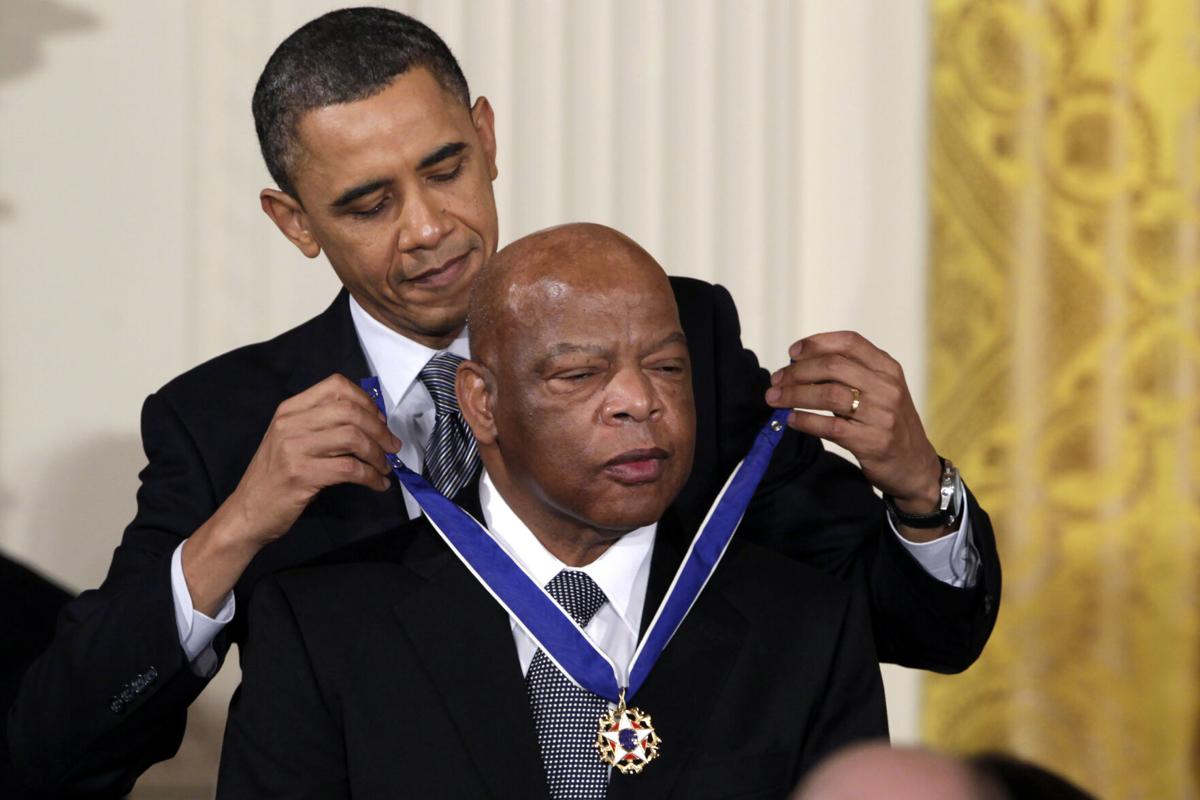
Letter #165 to friends et familiares: Good bye, John Lewis

“Do I not destroy my enemies when I make them my friends?”
-- Abraham Lincoln 

“If you can’t fly then run, if you can’t run then walk, if you can’t walk then crawl, but whatever you do you have to keep moving forward.”
-- Martin Luther King, Jr

John Robert Lewis never commanded my attention during his life-time. Yes, I admired what he said. But John Lewis was short, plain, quiet, and Black. My unreflective judgements never mattered to John Lewis or anybody else. 

So, who lost with such unthinking prejudice? 

Representative Lewis's pilgrimage from preaching to chickens as a toddler, to surviving Bloody Sunday in 1965, and on to triumphing in later life made an average man a great American. That greatness lay not in John Lewis alone, but in others, too.

In a fitting funeral yesterday, the nation celebrated that greatness and tasted the ingredients of John Lewis's "secret sauce":

  • consideration reflexive enough to care; 
  • faith tough enough to persevere; 
  • humility profound enough to forgive;
  • love rich enough to find the good in others; as well as,
  • courage gritty enough to pursue righteousness.
Two presidents did not attend that funeral -- one frail in body, the other failed in spirit. The absence of the latter eased the bereavement, sharpened the moment, and reminded us of the peril of being small-minded. That President's absence, ironically, started our renewal.

Representative Lewis laid the foundation of that renewal by showing us that, notwithstanding the accidents of birth or measures of ability, the questions -- the big questions -- in our lives remain simple and apparent to us all.

Obama to deliver eulogy for civil rights icon John Lewis in ...

The answers, too, are evident, if crushing. We saw, in the men and women who spoke yesterday at the funeral of John Lewis, leaders who had made mistakes, big mistakes. Bitterness, sacrifice, and imposed penance had followed those miscalculations. 

Representative Lewis's undefinable grace, an irreducible content of character, left him no alternative but to find the good, along with its possibilities, in those leaders. In that charity lay the way through those crushing answers, not for Presidents but for us. 

By John Lewis noticing the best in those leaders who spoke yesterday, they could see the best in us. Accordingly, this simple man, with his simple grace, not only reminded us of what American greatness should be, but also made most of us a little greater, too. 

Monday, July 20, 2020

Letter #164 to friends and familiares: CHINA

"We, of course, are saddened indeed by the events in Indochina. But these events, tragic as they are, portend neither the end of the world nor of America's leadership in the world . . . We can and we should help others to help themselves. But the fate of responsible men and women everywhere, in the final decision, rests in their own hands, not in ours."
-- President Gerald Ford, Tulane University, April 1975
"At what point then is the approach of danger [of the collapse of the Republic] to be expected [from an outside invader]? . . .  If destruction be our lot, we must ourselves be its author and finisher. As a nation of freemen, we must live through all time, or die by suicide.”
-- President Abraham Lincoln, Springfield (IL) Lyceum, 1838

B.L.U.F. (bottom-line, up front): time for a great power switcheroo between the United States and China.

INTRODUCTION
This paper does not analyse the state of the contentious rivalry between the U.S. and China. The essay reviews the current American-Chinese relationship and the state of play for the United States herself, reflecting themes in the popular press. The balance of the essay suggests a new foreign policy for the United States and her allies toward China.

OVERVIEW
As a Yank, I have to say that it is time for us to admit that the American Century is over. The United States is insolvent; debt levels in all borrowing sectors imply an eight-to-fourteen year payback. To achieve re-payment in eight years, all social programmes would be zeroed out and taxes high. Being the world’s sole super-power has led to a loss of the deep reservoir of goodwill built up by American missionaries and aid societies over the first 175 years of the Republic.

ln actuality, we are ten or fifteen years into the Chinese Century. Chinese economic growth rates have been the envy of the whole world for decades. This mighty expansion has also come at a shameful cost of:
  • Tiananmen Square;
  • Hong Kong;
  • misappropriation of technologies and industrial secrets;
  • widespread repression;
  • deepening corruption sustained by zombie financial institutions;
  • dubious data released on national health and other statitsics;
  • aggressive claims in the South China Sea;
  • aggression toward a democratic neighbour (i.e., India);
  • neo-colonialist development policies, etc.
Secondary sources (e.g., The Economist and Foreign Policy) have documented these draw-backs. Nonetheless, Chinese dominance and influence continues to expand, with mega-currency swaps carving out pockets of the renminbi being the store value currency with the rapidly developing nations (e.g., Brazil and Argentina). 
According to the Central Intelligence Agency, after rendering the yuan equal in purchasing power to the dollar, China’s adjusted G.D.P. is already 25% higher than that of the United StatesMeanwhile, back in the States, the coronavirus contagion has brought out into bold relief the impoverishment of American middle classes over the past forty years amplified by a deepening inequality between the races. Simply said, it is time for the American Republic to:
  • detach from the crushing expense of global dominance;
  • reform trade policies to re-tool to the extent that comparative advantages permit;
  • rebuild the educational system, especially for under-privileged children; as well as,
  • reverse the declining health profile, through attrition of benefits and addiction to opioids, of the nation over the previous half-century.
FOREIGN POLICY POST-AMERICAN CENTURY
My (quixotic) recommendations for consideration in the face of the loss of American power vis à vis China? Make a virtue of necessity by high profile initiatives including, but not limited to, the following:
  • hand off the global hegemon / policeman function to China, as the U.K. did to the U.S.A. in 1945;
  • in contrast to the discretion exercised at Potsdam, seventy-five years ago, by British Prime Minister Attlee and Foreign Secretary Bevin, announce the hand-off publicly;
  • in that announcement, openly welcome China's leadership in her century and count on her as the guarantor of peace in much the same way the U.S., the U.K., JAPAN, the E.U., Australia, SOUTH KOREA, Canada, New Zealand, TAIWAN, INDIA, South Africa, et al. have for many years;
  • work quietly with these sister democracies to strengthen the W.T.O., the United Nations, U.N.E.S.C.O. et al.;
  • pronounce what the U.S. and her sister democracies stand for by "appreciating" China's continuing ‘commitment’ to honour the common values in the current world order; as well as,
  • scale back U.S. war-building efforts due to the country's insolvency and stake out -- with our allies -- key interests, including the South China Sea, FORMOSA, the Persian Gulf, etc.
These ideas sound cowardly to those of us used to equating American exceptionalism with military power. American exceptionalism is real and was never about the power of weapons but of ideas; that exceptionalism ceased being unique generations ago. Fellow democracies and other nations aspiring to popular governance across the world share that exceptionalism today.

RATIONALE
(i.e., best-case outcome)
These ('out-there') ideas may confer upon the many nations alarmed by the excesses of Peking, consistently enumerated by the popular press, certain advantages.
  1. Such a dramatic shift will force China rapidly to clarify her intentions about her role.
  2. As the global cop stalking the street, China will be so bizzy that imperial aggression should become more difficult to pursue.
  3. With no more bickering about who is number-one among the democracies or the degree of asserted primacy of American interests, the U.S. can get on with her business as a stalwart supporter of human rights and republican governance, along with dozens of other nations.
  4. By crowning China as the 'king of the mountain', avenues of secondary attack open up easing and empowering the ability of N.A.T.O., Japan, Australia, South Korea et al. to chip away at China’s geo-political position and dissipate her power incrementally.
  5. As China eventually faces collapse -- as has the U.S. after more than a generation of being a 'hyper-power' -- strengthened international institutions rather than contentious nation states will be better positioned to mend the breach.


Tuesday, July 7, 2020

Letter-162 to Friends et Familiares: Race in America -- ¿Reckoning & Reconciliation?

A view of Black Lives Matter by an ageing White Conservative

NOTE: all embedded links indicated by bold green-font italics.

“’Racialism’ is racism with a triple-digit I.Q.”          -- Anonymous

« Qu’est-ce-que c’est un symbole phallus encore? »
« It’s your dick, idiot!”
“Oh . . . oops.”

-- A Midwestern Republican high schooler (i.e., me) in French Literature class discussing the poetry of Aimé Césaire, October 1974
  “Of course, all lives matter. Right now, Black lives matter a bit more.”
 -- Anonymous
Update as at 04mar24: as a control for the calculation of reparations -- stated as $10.3 TRILLION (roughly $12.6 TRILLION, inflation adjusted since July 2020) below -- I applied a weighted average of current hourly wages for four occupations construction workers, farm workers, domestic servants, and tradesman to an estimated 410 billion labor hours performed by slaves from 1619 to 1861. At an estimated average wage of $18.19, that reparations figure falls to $7.8 TRILLION, some 30% lower than the estimate stated below. I stand by the higher estimate as more comprehensive through scenario-testing based upon wealth rather than wages only.

B.L.U.F. (bottom-line, up-front). the protests following the murders of Breonna Taylor and George Floyd are at an inflection point: failure through justifying violence for short-term gains versus the hard work toward success over the next two generations.

INTRODUCTION.
As I remain a conservative by nature, current reports of looting and destruction of small businesses unsettle me, deeply. “Conservative by nature” means that my politics are centre-right and, more importantly, I tend toward prudence, probabilities, contingencies, and exit ramps. The United States has already failed twice to attain a full racial reconciliation and equality by setting things right for African Americans; hopefully, this third time will be our charm.

THE CURRENT STATE of FRAY
We live in the midst of a full-blown Black rebellion, one that is overdue. Hispanics, many Asian Americans and Muslims, as well as, for now, sympathetic Whites support this uprising following the police murders of George Floyd, pre-meditated, in Minneapolis six weeks ago and of Breonna Taylor, reckless, in Louisville before that. Ironically, the white supremacists and the gangster régime that coddles them also spark the impetus of the Black Lives Matter (i.e., B.L.M.) movement to act.

America is not in danger of B.L.M.-inspired anarchy, or facing a Trump-instigated reign of terror. Nevertheless, for the B.L.M.-led revolution to succeed, it will need to sustain the stalwart support of at least forty per cent of American Whites. That support will need to remain steadfast not only for today or tomorrow. Not just this week, month, year or even this decade. White support will have to continue for two generations — the time required to change a culture.

WHAT the BLACK REBELLION REALLY MEANS.
First, this rebellion will not degenerate into a race war since the economic disparity fuelling this resistance involves class as much as race. Many Whites now share the same economic interests as Blacks in the B.L.M. movement. Most other Whites outside of Black Lives Matter remain sufficiently decent not to force their Black brethren into a corner thus precipitating an existential struggle for survival.


While elements of the protest display some of the street politics of traditional anarchy, this movement does not yet impress me as an enduring concoction of socialism and anarchy led by a violent vanguard to usher in an illusory peace never realised. The principal elements catalysing and sustaining the B.L.M. movement appear to be:
  • autonomy assumed by more Blacks to reach a cultural and economic self-reliance for and by all African Americans;
  • an energetic push for justice  for Blacks — meaning justice in fact, life, law, and system — too long deferred and, therefore, denied; as well as,
  • final realisation of reparations due to the descendants of enslaved Black Americans to recover not only the value of labour stolen during 250 years of involuntary servitude, but also by 150 years systematic under-valuation of said labour.
SELF-RELIANCE.
Louis Farrakhan, the divisive leader of the Nation of Islam in the United States, the religious group known as the Black Muslims, remains a mystery to me. From what I have heard about him, the man strikes me as dangerous and prone to violence. Yet, in his long and discursive speech at “The Million Man March” a quarter of a century ago, Mr Farrakhan said one thing that has stuck with me all these years as absolutely valid: that Whites can not care enough for Blacks voluntarily to lift them into freedom in equality.

This call to self-reliance represents the long-term phase of the B.L.M. movement. Why would Moses march the Hebrews through a desert for forty long years in The Book of Shemot (a / k / a The Exodus)? To wean the newly liberated slaves from the Pharaoh’s certain but hard-earned lentils and grow into a culture of individual virtue and innovation. That required forty years, or two generations.

The long-term commitment contemplated here applies not only to Blacks and a critical mass of Whites, but also to Muslims as well as to Asian, Native and Spanish Americans. This long march of progress will be every bit as taxing and liberating for all Americans as it was for the Exodus or the Great Civil War from 1861–65 by:
  • breaking the chains of an underclass, the enculturated dependency of which systematically deprives millions of Black men and women from assuming their properly ordained statures in the eyes of G-D;
  • Blacks setting an example of the de-segregation of the heart and the hard work of breaking a cyclical culture of violence as defined by a scourge of Black-on-Black crime attendant to easy guns and drugs quietly condoned by too many Whites as “not our problem”; as well as, somehow,
  • cultivating the renewal of the nuclear family and an emphasis on meaningfully provisioned education across African Americana.
Along with millions of other fellow Americans, I have my ideas on how the larger society should redress these systemic shortcomings of our culture and political economy. All such ideas, save one, lie beyond the scope of this essay; the one exception being that every White, beginning with me, needs to embrace these challenges as ‘our’ problem, not ‘their’ problem. Shrugging my shoulders in indifference becomes complicity with white supremacists.

These practitioners of ‘eliminationist racism’ comprise the number-one terror threat within the United States according to the F.B.I. In short, for Whites to place sole responsibility of remedial action and initiative onto Blacks is to blame the victim. More resources for programmes in place are not enough; affirmative action alone was not enough. To reach a just society requires de-segregation of the heart, or a concerted commitment of will by each and every American. To do what? Not necessarily never to feel racism, but never to act on, or give voice to, that racism when it arises within each of us.

RE-MASCULATION of BLACK MEN
My thinking here comes from studying the Black revolutionary poetry of Aimé Césaire in a French Literature course in high school and my later reading of The Wretched of the Earth by Frantz Fanon. The take-away from these two writers is the necessity of violence for the reprise of Black male autonomy. Obviously, this kinetic road to one’s re-humanisation has its pitfalls.


Most delicate of these tensions remains the fact that many or most Americans in general, and Whites in particular, take a dim view of looting and what looks like wanton property damage and vandalism unrelated to the struggle for justice itself. There may be more latitude toward pulling down monuments or torching unoccupied police cars. These are common enough objects and replaceable, after all.

Nevertheless, busting up people’s shops and ruining their livelihoods, though almost certainly less frequent than anti-B.L.M. partisans assert, does not play well in the suburbs quickly wearing down the formidable and sustained level of commitment required of Whites (i.e., 40% for two generations). More Whites may acquiesce to looking the other way on police violence against Blacks in the face of such gratuitous violence, thus undermining the painful process of racial reparations and national conciliation.
In another respect, however, limited and highly visible destruction can catalyse the Black rebellion to sustain radical change and impress the message of that rebellion upon Whites. As Lawrence of Arabia noted that, for people in revolutionary ferment, looting often is less about opportunistic plunder and more an agitprop to confirm and inspire the bottom-up repudiation of a corrupted, unjust régime.

And, American Blacks have suffered long and hard under an unjust order. The question now arises, from my conservative world-view, of when to stop the current violence; indeed, anecdotally, the violence appears to be abating and its extent is overplayed. That is: ¿how close is the current street crime to the invisible line before it flashes red to less sympathetic Whites? Put simply: ¿when is enough, enough?

The brittle balance required to maintain the pro-B.L.M. coalition prescribes a switching point from violent to non-violent resistance. For me, at least, the protestors are fast approaching that limit. Now would be the ideal time for many repeats of what occurred in Louisville when protestors protected a policeman surrounded by a volatile mob.

B.L.M. participants may not be able to prevent looting or vandalism, but they can photograph or film the people leading it and report the looting to police. As the police arrive to the area B.L.M. coordinators then open a lane of approach for the police through the protestors. Above all, the great majority of protestors must practice zero-tolerance for the taking of any life, including those of policemen. Coöperation with police will more likely consolidate the necessary support among Whites of goodwill.

In the meantime, law enforcement needs to stop battering reporters and other innocents. Instead, police and crime detection professionals should investigate who is actually committing these crimes. Descriptions of recent ‘Anti-fa terrorists’ depict people whose behaviours correspond more closely with those of white supremacists (i.e., the number-one domestic source of terror per F.B.I. Director Wray).


THE CHALLENGE of REPARATIONS. 
If one is oblivious to history, as I was for many years when I was complaisant with my own racism, (s)he will likely dismiss the whole notion of Black reparations as reverse discrimination conferred upon Blacks for doing nothing. This dismissal is at best false and most likely racist. Reparations seek to restore to the descendants of slaves the value of the labour looted from their ancestors during 250 years of involuntary servitude.

In fact, additional largesse may well be in order to recover the amount of labour not fairly compensated during days of debtor prisons, share-cropping, Jim Crow laws, segregation, and a near-universal discrimination against African Americans. While affirmative action and civil rights laws have addressed these issues, segregation remains deeply entrenched; moreover, since 2013, numerous states have been undermining voting rights for Blacks and voting-age students, two core segments of B.L.M. and, coincidentally, segments of the population not known for an affinity toward the Republican Party as it now stands.
President Grant tried to monetise reparations for slaves in the 1870s but failed. A hundred years later, President Johnson made as strong an effort as President Grant had with the Voting Rights Act, the Civil Rights Act, the Fair Housing Act as well as programmes including Model Cities and Affirmative Action. The current round of demands for reparations indicates that, fifty years later, one can see that the Great Society has also failed. Both efforts tried hard enough, but not long enough.

Reparations calculations vary widely due to the sensitivities of assumptions and values assigned to parameters. The redemption value of Dr King’s defaulted promissory note ranges from $500 billion to four trillion dollars on the lower end all the way up to fourteen trillion dollars on the higher end; values seem to settle in the $10–12 TRILLION range. My particular calculations integrate the following five scenarioes into a composite reparations bill of $10,865,616,290,109:
  1. best case based on full and fair value of labour starting with the boom after the Civil War;
  2. worst case of permanently depressed agricultural economies but full and fair employment;
  3. the odious price of each slave in 1860 restated in today’s dollars;
  4. the historical valuation of forty acres and a mule in 1869 re-stated in today’s dollars; as well as, 
  5. earnings power from an up-dated version of forty acres and a mule (e.g., small tractor).
There is the question of costs of affirmative action of $590+ billion and cumulative losses from race riots, conservatively estimated at $10 billion by assuming a $2 billion worst case for the George Floyd protests. These total, conservatively, $600,394,566,141. Deducted from the gross bill of reparations, the net payable due to Blacks is $10,265,221,723,968.

CONCLUSION.
Victor Hugo observed that nothing is so powerful as an idea whose time has come. To realise that idea in the case of Black Lives Matter, however, one must recall and heed Ralph Waldo Emerson and Louis Farrakhan that envy is ignorance, imitation suicide. These thoughts delineate the opportunity and dilemma facing the Black Lives Matter movement.

Indeed, realisation through beneficial use of the $10.3 TRILLION net reparations bill, if collected, rests on profound changes with the hearts of Blacks and Whites alike:
  • switching to non-violent resistance as exemplary citizens;
  • restoring the full and just esteem of Black men and Black families;
  • educational opportunities for Black children renewed; and,
  • the final strides toward freedom taken by Whites intent upon, and with a steadfast patience toward, a new and better America.


Saturday, June 13, 2020

Letter 161 to friends & familiares; making sense of chaos at the core

LIFE GOES ON AND SO MUST WE

"But at my back I always hear, time's wingèd chariot hurrying near!" --Andrew Marvell, 1681

"And silvern chatter the pale ports o’ the moon. I said to Dawn: Be sudden—to Eve: Be soon . . . ." --Francis Thompson,1893

"Love is a bitter-sweet utopia." --Ned McDonnell, 1980

Ever had a life-event that, you know, you should leave behind you but never really do? Much like we remember the first time we fall in love, the first time that getting dumped crushes us, and the first-time grief’s lingering boney fingers curl around the heart.

For me, these three memories collided forty years ago today, when I had just graduated from Washington and Lee. The lady at the centre of his troubling trifecta? One Miss Leigh Woolverton of Ponte Vedra Beach, Florida. Her beauty, still fresh when she (rarely, now) shows up in my dreamtime, reminds me just how striking she really is, even four decades later.

Five days after my graduation from a college appreciated only later, I kept myself busy getting ready for one of the premier parties of the Summer of 1980 (for which I had FINALLY received an invitation).  The ironic timing of the ‘BIG EVENT’ on Friday the 13th added to its sizzle.

Being an idle past-time, vanity kept me busy and free of ‘taxing’ efforts like job hunting. So, when the old rotary dial phone, ossified, in my room rang, I ignored it blithely; I had more important things to do, like dry my hair ‘just-so’ for the evening’s festivities.

“Ned!” My sister was calling over from her bedroom, across the upstairs hall.

“Dickie Latture and Betsy Kyle are on the phone.” Immediately, the chill walked through me, like a wraith through a wall. Immediately, I knew these two frat-buds would have only one reason to call me here in Pittsburgh; fuck.

Still wet from the old-fashioned bath just taken, I slumped down and felt my back sliding down the white metal-mesh cover of the old radiator.  Naked, on the floor, I picked up the phone receiver. Betsy and Richard kept the call brief, their solemn voices already dripping with bereavement.

Leigh Woolverton, my first and quite unrequited love, had died, killed by a drunk teenager in a head-on collision.  The impact of the head-on collision had apparently driven the steering wheel and column right through Leigh, exploding her beautiful, beautiful form into the dark; mercifully, she had died instantly.

There are days even now, so long after the brutal fact, when I wonder what her last expression was, her last word, her last feeling. These insoluble questions create a pain in the lower back, a pain of the aching burden of unknowing. The funeral was to be in Jacksonville in two days.

Donning my coat and tie for the family sit-down dinner, I went downstairs to inform my parents. Fortunately, my sister, Claire, had briefed them from what she had overheard in those fateful, fatal minutes on the telephone.

The better money manager of the two of us, she instinctively, and charitably, offered to pay for the air-fare to Jacksonville out of her meagre savings from baby-sitting.
Looking at me with an urgent solicitude, Claire said, “Ned, I have money saved up so you can go to the funeral.” My parents nodded in assent, indicating a willingness to chip in.

Feeling inadequate to the task of public mourning and unwilling to accept help from anyone, I said quietly but abruptly, “No, thanks.”

After several more evasions, my sister looked at me while Mom and Dad grimaced and puckered their lips. No one was fooled. We finished our dinner.

(“Is Neddy in here?” Soon, Leigh sees me, since I am sitting near the Zeeb television idly watching a ‘Get Smart’ re-run with a pout because she has ignored me again. She straightens slightly and says gaily, “There you are, silly boy!” She giggles with childlike innocence and laughs and bounds diagonally across the room, sitting right on my lap her arm wrapped around my neck.

Little do I understand beyond my self-centredness. Apparently, Leigh has been simply getting coloured. Jealousy really becomes me very little. Soon, relatively late in life, I will find the restoration of childlike wonderment that comes with getting coloured. Ingrate that l remain, I notice first that my thighs are tingling into sleepy numbness.

Now, I have seen for myself that this beauty, blond – I mean, no Alex Haley roots – hair streaming to her shoulders. First hand, I know that physical beauty exquisitely proportioned through years of being an equestrienne, with an earlier moonlight setting off perfectly sized breasts so much like Leigh herself: supple, inviting, firm, and resolute. This girl has no fat anywhere. Now, I face a dilemma of almost painful proportions.

Muscle does weigh more than fat; I have heard that but remain too skinny to care, until now. She wriggles affectionately on my boney lap, perhaps in a desire to be closer to me. Maybe, finally . . . . But, no, it is more likely my boney thighs and knobby knees cause Leigh discomfort. Her butt looks for relief.

‘Get Smart’ is one of the dumbest fucking shows ever made; who can enjoy this loser, Maxwell Smart, with a capital ‘L’? And therein lies the sadness of that moment. Leigh giggles gaily through the episode, like I used to as a nine-year-old. It never occurs to me that she is happy, really happy, to be sitting there, sitting there with me. As she laughs at some stupid-ass remark, “Would you believe . . . .”

Leigh flicks her hair behind that inviting ear 
 like a host of golden daffodils dancing in the breeze  that ear that I have kissed before, her pearl earrings that much more elegant for being so easy to overlook. Colouring has made her eyes into flying saucers; she stares strangely at the screen, digging into it, looking behind it. Her nose, with its perfectly chiselled curve makes me smile, as I could run my hand index finger off it into a friendly wave for . . . .)

As I seated myself at dinner, my ungrateful response had spoken its truth; Leigh and l truly had gone our separate ways, albeit mine was the less willing. Like all unrequited lovers, I had repeated the tired platitudes of hope like ‘You’ll see, she’ll come to her senses . . . .’ or 'Well, half a loaf is better than none.’ That tripe had sustained the last sliver of my self-respect or, at least, my conception of it.

During the brief pause after dinner, alone again in my room, before leaving for the party, I rehearsed my evening's courage by muttering, to myself, that Leigh could not evade me that easily. That pathetic declaration fell flat. Nonetheless, the flush of tinglies that followed the fake fortitude felt like a quiet one-way communiqué from Leigh saying that she did love me, but not in the way I had wanted her to, and that she still existed, somewhere, rooting for me. 

(“Oh, Neddy, don’t be absurd. You’ll meet somebody else, soon enough. You always do.” That is it; circuit-breaker switches and HE takes over. HE lives in me and is me, but HE lives alone, away from me. HE enters those situations when an unwelcome reality has broken through to me, making the attendant feelings unsupportable.

HE lives in my deceit; all reality remains bearable because there is often no choice. Grow up, already! That the kind of thing. HE says, “But, Leigh, I will miss you.” He makes sure I go no further. The determination finally to tell this woman, after months of dithering, that I love her and will love her forever falls to dust.

Leigh will surely laugh at me, hysterically. HE will not permit me to risk it. HE may permit humility, but HE can not abide by humiliation. Leigh says something else that l can not, perhaps refuse to, hear. HE guides me now to escape these feelings of betrayal and the bitterness of five months wasted in a stupidly infantile infatuation.

HE will preserve my honour, so I delegate my escape to HIM. Accordingly, I stand up stiffly, and inform Leigh, as amiably as contrived stoicism allows, that the good-bye dinner has been a pleasure and that I shall be getting on home. Leigh, seeing I am hurt, offers me a ride before she ventures back over to the mountain to Sweet Briar.

Yet again, I wave her off politely, saying a walk will do me good since I have eaten far too much. Of course, that is an off-white lie, since I kept my eye on the right side of the menu all evening long, setting myself up for embarrassment when I ordered the un-filleted fish dish, not knowing what I was in for, just to save two bucks!

About ninety per cent of the way home, after a mile or so of walking, I cut into the cemetery to the grave of, with a tasteful monument to, General Stonewall Jackson. HIS mission accomplished, HE leaves me utterly alone to weep, inwardly, for the loss of something I have never had to lose.)

Alone in my bedroom after dinner, in the anguish of that moment and whistling Dixie in the dark to keep up my courage, I said out loud something like, “Well I guess I won’t be whining about you behind your back anymore!” Of course, laughing at death in the face sounds strong and defiant; it rarely works. Another lesson in a dense night. 

Black humour dispensed with, I decided to go to that ‘BIG EVENT’ with my best friend from grade school and two of his female classmates from Kenyon. Bravely, or so I concluded, I acquitted myself as entertaining for those three hours. Getting back from the party early (i.e., midnight), my sister asked me again if I would like at least to borrow the money for the air-fare needed to attend Leigh’s funeral. 

To Claire, I simply explained that Leigh and I were no longer close. While Leigh’s death had shocked everybody in her wide circle of friends, I reasoned, the funeral should be for others still very much in her life.

Deep down, I wanted to say ‘yes’ to my sister’s gracious offer but brushed my feelings aside by taking pride in my apparent indifference, failing also, and utterly, to appreciate my sister’s generosity. Only later did I realise how over-rated and over-priced personal dignity really is. No surprise: that night stretched into a sleepless one.

About four-thirty in the morning, I gave up trying to sleep and went down-stairs. Without hesitation, I looked for the right medicine: a stiff bourbon and water. Confronting the inward crevasse and its blackness, however, impressed me that liquor would only make things worse. Instead, I played my favourite music a couple of times through since it brought
Leigh's machine-gun giggle faintly back in a deathly draught . . . forgotten, fleeting
.

CLICK BELOW

'Sequoia Forest', short skip (from 31:44 to 34:17), 'Love Is A Reflection In The Mirrors Behind Your Eyes - Sunrise In Africa', Teruo Nakamura

(Decked out in my second-hand full dress, used once or twice a year on the periphery of the débutante circuit in Pittsburgh, I wonder if I have over-done it. Leigh takes forever to appear. Two friends are helping her, I will soon find out. For now, I swear off women as insufferable; beautiful yes, but insufferable.

Anxiety begins to build; my timing stinks, on this occasion to go colouring. One of Leigh’s friends appears, ready herself for W.&L.’s annual dance, and she seems to suppress a smile; it’s Betsy, whose cinnamon hair, blithe smile, and sunny disposition makes her an All-American girl all the way. In the Zeeb house? Of course – we treat women with respect.

Then I see the bottom of black evening gown swirl below the ceiling that cuts across my view of the top of the stairway. Suddenly, I stand, frozen with anticipation, in the lobby of the fine old fraternity house. Soon, enough, Leigh comes into full view. A simple brooch and a string of pearls with the same, subtle earrings. That blonde hair, prepared but quietly so.

Leigh stands in front of me at the small corner landing, four steps up the stairway, holding her hands together in front of her, shyly. Her blue eyes gaze into mine, into me, through me
been that way since we first met four months ago on the Sunday brunch at the frat house. Her slight ascension perhaps awakens some lost archetype of the beneficent mother of God.

Now, definitely the wrong time for getting coloured. The sight becomes too much for me – such beauty, such life 
– Leigh looks at no other Zeeb, but at me. The colouring becomes too intense as I feel so transparent, so insignificant in the face of the perfection of feminine beauty, that I feel myself turning wraith-like, dissolving into eternity.

While such significance of peaking into my colours starts the evening, the mid-winter ball collapses under the weight of believing my inadequacy to be on unmistakable display. The night meant for transcendence ends in alienation. Leigh never leaves me, really, but, by night’s end, she senses there is another meant to be in her future.)

Presently, on the second run-through of that jazz music I was listening to, the skies started  turning slowly and faintly pink through the lead-glass windows. At that point, I heard the tinkling of the dog's license and tags as Finder ventured downstairs from my parents’ bedroom. Presently, he stood up to my lap as I sat there in the living room; I rubbed Finder’s head back, as he stretched himself awake, his paws sliding up then down my belly.

Returning the favour, I pulled his upper eyelids back to show the whites above them. How our dear, dear beagle loved that simple affection, one I had resolutely recoiled from extending to Leigh. My mother soon followed him. Finally, I felt ready to make my grim words dance. Mom kindly brought me the Crane’s double-folded stationery and we talked, meaningfully, for the first time.

Subsequently, I wrote a moving, sincere, and effortless note to Mrs Woolverton. As to attending the funeral, my family knew me well enough when to leave me be, notwithstanding feelings expressed clumsily by me at dinner nine hours earlier. My real reason for not making that trip South lay not in humble recognition of my lower spot in Leigh Woolverton’s pecking order.

Instead, my reason lay in simple self-absorption: I thought showing up would make me look ridiculous. Her
Sweet Briar friends would say, “What is he doing here?" How self-centred I was. Accordingly, on the day of the funeral, I went to the Catholic Cathedral in Pittsburgh for the noon-time mass as a proxy memorial service. That boney-fingered grip tightened around my heart, relentlessly wringing one, just one, forlorn tear from one reluctant eye.

(“Oh, I just don’t know.” Leigh’s voice over the phone, clear as always, strikes a pensive note.

“Know what, Leigh?”

“Me.”

“Well, what about you don’t you know? Perhaps, I can fill you in . . . .” Her laugh is more adult now, not the innocent giggling of a child coloured into the night.)

As that tear crawled slowly over my cheek-bone during the priestly invocations ringing over the old sound speakers, the reality of that Friday the 13th finally etched its way into my life experience, forever changing the way the world worked, at least for me. Leigh had a life-force that had been, and should have remained, unstoppable and unquenchable. Great events and accomplishments yet awaited her. Frankly and sincerely, I asked God why Leigh Woolverton and not me?

(The telephone conversation  continues as Leigh says suddenly, evidently summoning courage to do that following a few seconds of pregnant silence, “Well, Ned, what if I told you I am lesbian?”

Truth be told, I had heard this rumour before but dismissed it for reasons of obvious self-interest; the source being a few fellow Zeebs whose overtures Leigh has rejected brusquely. I have never believed it, nor will I, ever. Leigh may not love me but that does not make her a lesbian.

Straightening up in the old Windsor chair, hearing it creak under the strain, I feel its rods rubbing into my shoulder blades. I say unevenly, “Well do you think you are a, you know, a lez?”


“Lesbian, Ned, LEZbian.”

HE is back looking at me, standing behind the phone-stand. This time, I wave HIM off. Albeit inadequate to the task, I prefer to go it alone. So, I quip, “Well these S-A-T words always get me.“

Leigh laughs her machine-gun giggle; she relaxes. “You are a funny boy sometimes. But seriously, Neddy.”

“Leigh, I know you’re not kidding. But what am l supposed to say?” She exhales audibly, disappointed that I have failed again, this time, to knock the change-up out of the park. But all the choking up on the bat has never spared me from piss-poor hand-eye coordination.

So, I continue with an ungainly sincerity, “Well, I guess if you think you’re a LEZ-BEE-ONNN,” she laughs as l go on, “then maybe you are one. What the Hell do I know?” HE is back a second time, unwelcome, to extricate me from this onrushing castration; this time, I flip the bird [i.e., by extending my middle, so called ‘mafia finger’] at HIM and HE exits for good.

Leigh snaps me back to the real world. “Aren’t you, like, disappointed or something?”

“Leigh, honestly, I don’t know what I think right now . . . but this much I can say . . . .”

My pause is tactically timed. After two seconds, that seem more like minutes, Leigh displays anxiety – my God, the woman is human! – as she implores, “Wellll?”

Speaking thoughtfully, with an odd sense of confidence, I say tenderly, perhaps for the first time in our intermittent love affair, and shunning the usual requirement of entertaining her, “I don’t know about all that stuff, but you could tell me that you are an axe murderer and – give me a few days – but somehow, some way, I would find a reason that, though all axe murderers are evil, in the case of Leigh Woolverton, there is an exception to prove that rule.")


How could the inevitable shining of Leigh’s inexpressible arc be subverted like this? With the mere snip of a thread in the tapestry of time now rendered imperfect? Leigh Woolverton’s sudden departure made no sense to me, no matter how hard I tried to fathom it. From that moment on, I understood what the older people had meant when they talked about living riddles, never to be solved, left by those who leave before us so they can remain alive in our hearts.