Life of an average joe

These essays cover a tour in Afghanistan for the first seventeen letters home. For an overview of that tour, and thoughts on Iraq, essays #1, #2 and #17 should suffice. Staring with the eighteenth letter, I begin to recount -- hopefully in five hundred words -- some daily aspects of life in Mexico with the Peace Corps.


Saturday, December 12, 2020

Letter #168: Trump may fade but kulturkampf will not

". . . . certain socio-economic changes, notably the decline of the middle class and the rising power of monopolistic capital, had a deep psychological effect. These effects were increased or systematized by a political ideology – as by religious ideologies in the sixteenth century – and the psychic forces thus aroused became effective in a direction [for the lower middle class] that was opposite to the original economic interests of that class. Nazism resurrected the lower middle class psychologically while participating in the destruction of its old socioeconomic position." --Erich Fromm, 1941.

B.L.U.F. (bottom-line, up-front): No, Rash Boombox (d / b / a Rush Limbaugh) et al. notwithstanding, secessionism does not pose the threat of infection that the coronavirus contagion does. Yet, the country, our country, must face up to cultural divides too long exploited by demagogues. This split shall become even more apparent following the Supreme Court’s public repudiation of the premise and the argument underlying a recent law-suit from Tejas, effectively ending, at least, the bloodless phase of Trump’s attempted coup d’état.

INTRODUCTION
The COVID epidemic across the United States has not divided the United States any more than the despicably racist occupant of the 0val Office has. Both have brought divisions, dark divisions, into the public -political discourse. This meticulously documented essay by liberal historian, Dr Heather Cox Richardson, serves as a wake-up call to disentangle the two forces – the coronavirus contagion and Trump's attempted coup d'état – that bring out in bold relief the underlying cultural divisions.

One may disagree with Dr Richardson, as I frequently do, but her fine work is the source of perspective in a time of clashing and confusing cross currents. Several of the links in this essay are swiped, shamelessly I assure you, from her daily ‘sources’. Please note that, unless I stipulate that some statement is attributable to Professor Richardson, anything I say reflects solely my thinking, or lack thereof. As it is, the good political historian's influence will flow these thoughts.

THE DIVIDES
The source. Traditionally, one has seen a split in the “theories of life” among and between regions and areas across the United States (e.g., the coastal cities versus the great plains) as well as within them (Chicago versus down-state Illinois). The most consequential, of course, is the central division that led to secession one hundred sixty years ago followed by the Great Civil War. These divisions go back to the Founders when the urbane Alexander Hamilton clashed with President Jefferson and his vision of the ideal democracy with the yeoman farmer. One saw it later with President Jackson’s feud with Nicholas Biddle and the privately chartered central bank of the United States.

In the seven decades before the Civil War, slavery radicalized this cultural wedge as a Southern planter plutocracy insinuated itself into control of the Federal government and policy. Ironically, some of the greatest minds of that era, arrayed on both sides of the divide, had strikingly similar views that differed decisively in nuance. One such split was Jefferson’s idealization of the yeoman farmer versus urban political organizations along the East coast (e.g., New York and Philadelphia); later the Great Lakes; and, ultimately the West Coast).

The similarities. President Lincoln’s initial views toward slavery were those of non-extensionism so ‘free-soilers’ could make a living. Free-soilers were white farmers homesteading in the Midwest, emerging as America’s heartland. Many founding Republicans did not argue against slavery as much as having no blacks at all, save a few freedmen, tragically and often unwelcome by their white compatriots, in the terrirtories in great plains. Restricting the free-soil to free whites homesteading sounds an awful like President Jefferson’s ideas about yeoman farmers, ¿doesn’t it?

The difference, of course, is that President Jefferson was a slave-holder, eventually addicted to that systematized and degrading exploitation. President Lincoln, himself a racist by cultural bias (as many of us are today; e.g., me) became a model of citizenship by growing while he was President and maturing his vision into a conviction of universal liberty, enfranchisement, and conciliation. Such growth by a President in office – recall that other favorite son of Illinois, President Obama – is hardly the norm. 

The contemporary choice for those whites, imbued with a culture of racism, remains stark: ¿do I combat this racism within me or let it flourish? Another unsettling similarity between slavocrats and Lincolnian Republicans is a key tenet argued by Vice President John C. Calhoun and Dr Richardson’s view of President Lincoln’s view of innovation and progress. The big difference, again of course, was that Vice President Calhoun’s theories served infamously as an apology and indirect justification for his ‘peculiar institution’. Vice President Calhoun’s ‘March of Progress’ stipulated that upward social mobility among small farmers and merchants would pressure the slave-controlling élite out of any complacency and into accelerating progress as the leaders of Southern society.


Dr Richardson argues that President Lincoln introduced an alternate idea of innovation and progress: that it was a bottom-up rather than top-down process and that President Lincoln sought to empower the common man. (General discussion minutes 31-42; definition minutes 36:00-37:30.) That rings reminiscent with Calhoun’s thinking (minus the racism), ¿doesn’t it? To be clear, Rash Boombox's mind will never rise to that of Vice President Calhoun. We are a point-of-pivot between the top down individualism and bottom up communalism.

Boombox, an undeserving recipient of the President Medal of Freedom from Trump – one demagogue anointing the other – is a durable but ultimately historical ephemeron craving attention rather than wisdom. (Erich Fromm nailed it with the Rush Limbaughs and other macho mouths of the world in 1941 by writing in his great work, Escape From Freedom: “If the meaning of life has become doubtful, if one's relations to others and to oneself do not offer security, then fame is one means to silence one's doubts.”)

The rub is that Trump uses the populism, as Michael Moore foresaw in October 2016, of the urban-rural divide as a cover story for his agenda of business oligarchy and people like Rash Boombox and Congressmen Nunes, McConnell, Paul, Cruz, Cotton, and Collins actively enable it while craven quislings in the G.O.P. like Senators Ernst, Kennedy, et al. permit it. No, conspiracy here, but a coincidence of interests of ten difficult to brake then break.

Undoubtedly, Vice President Calhoun despicably defended slavery yet, paradoxically, he remains one of America’s foremost minds in political theory. Even now, some of his political thinking lives on as producing some of the freshest ideas this crazy republic has produced. His ideas on concurrent majorities remain applicable today. For example, instead of states enjoying a nullification right to protect their own sordid rights, segments of the population would benefit from such a right of concurrent majorities and ought to, in the case of women, be able to exercise it. 

Practical example. Roe versus Wade should not be overturned and abortion rendered illegal without a concurrent referendum among women in the United States eighteen years old or above of any citizenship or status. Why? Because overturning Roe versus Wade and / or passing legislation that inhibits abortions by those women choosing them abridges their natural right to privacy with respect to personal sovereignty over their own bodies. In a concurrent referendum, a super-majority of women (i.e., 60-75%, as stipulated) would have to consent to the abridgement of a natural right before the state could deprive them of it.

My knowledge of the industrial era of the United States is limited. Suffice it to say that, since 1876, Party roles have switched and today the Republican Party is the élite Party fronting for plutocrats who are not planters but profiteers. This process has accelerated demographically after 1968 and economically after 1980. These days, since the 1890s, the Democrats are the bottom up Party seeking to empower the common man with Republicans having made their ideas plain under Trump.

Summary view. So, in addition to the city-country gap, one sees a wider gap between who fuels progress: people innovating from the bottom through communal support or those at the top, the individuals charged with leading the progress. The strands are clear from the Republic’s earliest days:

  • top down personified by Messrs Hamilton, Biddle, Hoover, Reagan, G.W. Bush, and Trump;
  • or bottom up with Messrs Jackson, Lincoln, La Folette, F.D. Roosevelt, and L.B. Johnson as well as Ms Chisolm; or,
  • surfing on two boards featuring Messrs Washington, Cleveland, T. Roosevelt, Eisenhower, Ford, G.H.W. Bush, Clinton, and Obama as well as Ms Clinton.

The struggle for the country is to straddle these two discordant themes so all can work together for the common good. President Biden thus far appears to be intent on mastering the precarious and perilous art of surfing on two boards by openly building a new and open coalition while keeping its leadership moderate.

ALONG COMES COVID
The cultural divergence polarizing since the 1980s has featured right-wing intellectuals like Patrick Buchanan calling for a kulturkampf. As a young man, I was initially sympathetic to these conservative concerns against godless secularism underlying this kulturkampf, principally with respect to being pro-life and supportive of school prayer. In the mid-1980s, Patrick Buchanan began to alienate me from this right-wing push-back with his odious comparison between gays suffering from A.I.D.S. and the punishment meted out by G-d against Sodom and Gomorrah.

This culture war has gradually crystallised into the direct attack on our participatory democracy waged and perpetrated by Trump, his ideologically irredentist allies, and too many craven quislings in the G.O.P. These demagogues, racists, élitists, and cowards are mostly white men over the age of fifty. A few lonely voices in the G.O.P. have pushed back against Trump; those in office have often paid a heavy price.

If my erstwhile Party of Lincoln is to survive, these oldsters representing a dangerously opportunistic ideology of cupidity must be cleaned away and room made for conservative intellectuals with fresh ideas without the years in power to make them crave job security over public service. In the interim, the epidemic has wrought its havoc on the world, but most particularly on the United States by laying these divisions bare with too many of our compatriots falling through the ideological cracks. The rural-city split has manifested with ‘red’ states (i.e., chronically Republican) being rurally oriented and reflecting, often crassly, the Jeffersonian yeoman farmer.

At its best, this vision represents the core American values of thrift, self-reliance, living in peace with one’s neighbor, and personal integrity. At its worst, this vision represents darker core American values of racism, neglect for individuals, and blaming the victim in the name of assuming personal responsibility. These values need to be promoted and pruned selectively; they remain anterior to the assumed utility of capitalism in allocating scarce economic resources efficiently. The urban side is more communal by virtue of population density and argues that people should have the opportunity to make money no matter who they are.

This vision reflects a different array of values. At its best, the urban vision manifests in communal economic rights through unionization of the work-force, providing universal access to education and medicine, and pursuing distributive justice to expand the middle class. At its worst, these alternate values include the excesses of wealth, the zero-sum reality of social Darwinism, and institutional corruption. The poisonous paradox here is that the rural states have rejected ‘tax-&-spend’ liberalism exemplified by Medicaid extensions under the ‘Affordable Care Act’ (a / k / a ObamaCare).

In doing so, and in supporting elected officials sympathetic to Trump’s élitist power-grab, these people are heading toward catastrophe in the shadow of an out-of-control epidemic in the remote areas as my writings on the coronavirus contagion have warned repeatedly. In her ‘Letter of an American’ for 10dec20, Dr Richardson summarizes this situation aptly, at least from my particular perspective. The evidence of this unintended self-immolation?

The seventeen state Attorneys General supporting the Texas law-suit seeking to overturn the election results in Georgia, Michigan, Pennsylvania, and Wisconsin (now joined by a majority of Republican House members and, of course, Trump).  With the possible exceptions of Florida and Tennessee, these are rural states that desperately need the largess of Medicaid assistance due to hosting fewer doctors and facilities to combat COVID; a large majority of these states has either rejected or implemented half-heartedly such health-care expansion.

Yes, this preference away from 'socialized' medicine may reflect rugged self-reliance, a core and worthy value, but it short-changes the dignity of poorer Americans. The influence of the other divide of – individually versus communally led – innovation is more subtle. One touchstone for that split may be the focus on ‘shareholder wealth’ maximization and rewarding individual achievement with enrichment starting with the arguments of Ayn Rand in the mid-twentieth century.

President Biden, in seeking to surf on two boards, is assembling an urban-based, politically progressive voting coalition while remaining moderate on any progressivity in taxation. Which of the two boards will assume paramountcy waits to be realized. The 2020 election and the necessity of overcoming Trump’s evident neglect of the pandemic should augur for a more communalist governance now that the Supreme Court has manifestly and unanimously rejected the premise and, with the two dissenters, the logic of the Texas law-suit.


Wednesday, December 9, 2020

Letter #167: Free will and determinism: ¿realization or resignation?

"Ned, what happens when we die?"
"Not sure. Tell you what: I'll be sure to send you a post-card."

". . . . these methods (e.g., 'customer is king') of dulling the capacity for critical thinking are more dangerous to our democracy than many of the open attacks against it, and more immoral--in terms of human integrity--than the indecent literature, publication of which we punish."    
-- Erich Fromm, Escape from Freedom, 1941.

"G-d has a plan for you, Ned."
"Well, I'd appreciate it He'd clue me in, you know?"


B.L.U.F. (bottom-line, up-front): Free will feels right, but determinism is closer than one would ever suspect, particularly with the 'theodicy' (i.e., the best of all possible worlds).

INTRODUCTION
Recently, my niece analyzed my natal chart, basically a sky-map of the exact positions of the planets in the solar system at the exact minute and particular place of my birth. Astrology excites comments from skeptics. The discussion became heated at times, which set me to thinking why since I myself am a skeptic. In reviewing these discussions, none of which were on F.B., I sensed that a larger issue was in play.

PLEASE note that the service performed by my niece in reading my natal chart was triple-A all-the-way in her professionalism, thoroughness, and her uncanny insights that taught a (sixty-three year) old dog (i.e., me) some new tricks. Thank you, Miss Elizabeth Purnell of Brooklyn, New York. If the reader trusts astrology, (s)he would trust my niece and her services. Of course I am not biassed. 😉

DETERMINISM versus FREE WILL
The common argument, if not consensus, postulates that one can not, or, at least, has not yet tested the likelihood of truth of Astrology through use of the scientific method. Frankly, I am old enough to know that many things can not be reduced to the scientific method. That "something more" basically boils down to a lack of comfort with the possibility determinism.

This essay makes a case in favor of the thinking written by Gottfried Leibniz, German philosopher, in the early eighteenth century in his great work on theodicy, or the idea that, notwithstanding the evils of suffering and wrongdoing so evident around one, this world remains the best possible under the stewardship of G-d. Leibniz's thesis basically apologizes on behalf of G-d for permitting the evil that man created as 'necessary'. 

The essay basically argues that through the telescope of modern portfolio theory, one can see that theodicy can still function in the wider context of free will in our day. No way out of the dilemma of determinism and free will likely ever emerge as, like Astrology, the scientific method really can not test out answers empirically. Humankind, therefore, will wrestle with the question. 

Any consensus will not last due to the cogent criticisms of either argument by its opponents. Any answers can not be reduced to the scientific method. Determinism sounds un-hip to the elbow-patch crowd, but minds far better than mine believe that determinism still has a role after "A Century of Self", albeit it is manufactured more by man than by G-d or by fate. Erich Fromm wrote in Escape from Freedom (1941):

"The ‘style’ of the whole period corresponds to the picture I have sketched. Vastness of cities in which the individual is lost, buildings that are as high as mountains, constant acoustic bombardment by the radio [i.e., television, audios, videos, etc.], big headlines changing three times a day and leaving one no choice to decide what is important . . . these and many other details are expressions of a constellation in which the individual is confronted by uncontrollable dimensions in comparison with which he is a small particle . . . He can act; but the sense of independence, significance, has gone."

Leibniz: catch him if you can
The whole idea of necessary (determined) and moral evil argued by Leibniz confused me because I do not have the mind of the 17th century during which G-d was quite alive with a mind "above" reason. People simply did not go there. We live in an era in which a famous atheist, and a very enlightened human being, seriously sought to devise an equation of everything. 

There is no question of free will anymore, Freud notwithstanding. We also live in an age defined by four horrific wars, making the idea of this world being the best possible world absurd. So, I could not understand Leibniz until I put my finance cap on and thought about portfolio management. You see, Leibniz views certain evil acceptable to God because it leads to an optimal, not perfect outcome. 

Gottfried goes to grad school for an M.B.A.
Then I thought through Modern Portfolio Theory. That theory reduces the aggregate behavior of a securities market (i.e., the stock market) to the classic equation of a line plotted on a Cartesian coordinate plane. 

First a refresher on, or de-coding of, what "y=mx+b" means . . . The Cartesian plane, shown by the grid-marks in the illustration, is split into four quadrants by two axes: a vertical axis (y) intersecting a horizontal axis (x). That equation plots a dependent (calculated) value based upon the influence of an independent (i.e., input) value. That equation is: 

  • y = mx + b; 
  • where 'y' equals the calculated or dependent value;
  • where 'x' equals the independent of input value;
  • where 'm' equals a pre-determined slope (i.e., the movement on the 'y' axis relative to the movement on the 'x' axis); and,
  • where 'b' equals the point at which the line crosses the 'y' axis.


source: https://mathbitsnotebook.com/JuniorMath/Graphing/GRLineEquations.html  

Evil is akin to risk of loss in the old capital asset pricing model (C.A.P.M.). The y=mx+b equation uses different, including two Greek, letters. In a simplified re-telling:
  • y = mx + b;
  • where, in the C.A.P.M., y = R for total return of an individual security or portfolio (i.e., dependent variable or calculated value);
  • m = Beta (slope) for sensitivity to market movements, or market risk;
  • x = expected market return or MktRet (i.e., independent or input variable);
  • b = Alpha (y-axis intercept) as return unrelated to the market movements; and, therefore,
  • R = β(MktRet) + α . . . OR . . . R=α+β(MktRet).
Please note that the 'αlpha' factor has two components.
  1. The risk-free rate, or the time-value of money. This rate is what one would earn if (s)he did nothing with the money. In the real world, one assumes this value to be the interest earned by investing in three-month bonds (i.e., treasury bills) issued by the U.S. Government. 
  2. The company specific returns, or returns of an individual stock attributable to factors unique (i.e., idiosyncratic) to a particular company (e.g., quality of management, company pricing strategy, etc.)
  3. Since the risk-free rate is the same for all, it drops out as a 'value-driver'.
  4. The idiosyncratic returns of various companies tend to cancel each other out (or so the theory postulates).
Along comes Gottfreid . . . There is systematic risk which no one can avoid; it is like the systemic evil born of original sin and nature's imperfections in the world (e.g., an earthquake in Lisbon) that act as universal sources of pain and tragedy. The sensitivity of one to that evil corresponds to the 'βeta' of the C.A.P.M

Then there is moral evil, the action done by the free-will. That parallels idiosyncratic or unsystematic risk. (On the up-side this unsytematic risk is known as 'αlpha' and people go as mad hunting for it as did the conquistadors for the fountain of youth; on the down-side, negative αlpha often means time to dust off the résumé.😱)

In a diversified risk-managed portfolio of stocks, for example, the market risk is assumed by everyone. Unsystematic risks can be diversified away as unique weirdnesses of many different securities tend to cancel each other out. Such an absence of coincidental behavior corresponds with independent events, or acts, of free will.

Eventually, an efficient frontier of optimal (i.e., likely to be the best possible) returns emerges, based on the amount of systematic risk assumed, or the sensitivity to general evil one is willing to accept. For example, people continue to buy and build luxury homes on beaches, though the property hazards (i.e., sensitivity to the systemic risk-as-evil, in this case hurricanes and erosion) stare them in the face from day-1.

¿Theodicy or the idiocy?
So, in Leibniz's world, G-d is the portfolio manager and foresees the petty evils of people exercising free will and allows for a certain element of universal risk (i.e., evil or, nowadays, suffering). Together, these universal risks-as-evils that G-d assumes, or permits to exist, produce the highest return of happiness to the people of our fallen world, which is, ironically, managed into being the best of all possible worlds.

For the greater reward, the more risk (or suffering) that G-d assumes into our world. Put another way: for the higher eventual happiness of humankind, the larger of acceptable evil permitted by G-d. The last element of the old C.A.P.M.-as-analogy is the 'αlpha' return (specifically, the component apart from the risk free rate and independent of the risk premium expected by the investment's βeta), which is not explained by the systematic / unsystematic risk factors. 

That risk-free rate of return is positive; as such, it may serve in this analogy as G-d's unconditional love for man expressed as G-d's grace. (Or, alternately, man being created in the image of G-d.) Consequently, an evil man using free will has to burn through G-d's grace, freely conferred upon him as a birth-right, before his soul is extinguished (i.e., the αlpha turns negative). This accounts for the difference, in traditional R.C. theology, between:

  • venial sins (i.e., minor infractions) absorbed by G-d's unconditional love as expressed by the given risk-free rate for a lower but still positive y-axis intercept; and,
  • mortal sins (e.g., the seven deadly sins), the commission of which consign people to HELL as their gravity exceeds G-d's unconditional love, thus creating a negative αlpha or a negative y-axis intercept.

What about sincere atheists?
Atheism -- at least as I see it practiced among atheists I know -- is not about the decline of humanity, but of the expectation of humanity's cracking the code of knowledge that used to be "above reason", as Leibniz asserted three hundred ten years ago, and, therefore, reserved to G-d. G-d and religion remain important to me, but these personal preferences would be deeply heretical to a genius like Leibniz.

The history versus theodicy rift
Theodicy does seem like the idiocy in the face of four globally catastrophic wars, genocides, colonialism, slavery, climate change as well as pandemics like the 1918 flu and COVID. An apologist for Leibniz could argue that God permitted these vast evils because they modernized technology, transportation, food production, 
economic structures, and security as well as medicine and daily health.

These advancements, albeit commanding a high price, enhanced the optimization of this best of all possible worlds. To me, at least, such rationalizing represents a ridiculous argument. Another point worth considering is the possibility of determinism on a ‘portfolio’ level. That is to say, in parallel with modern portfolio theory, G-d determined the end state – some utopia, live or memorex – but not the actions of specific people in getting there.

Any one person would inevitably deviate from the perfect path to that end-state due to personal short-comings and elements of individual free will. Across humanity, however, these ‘unsystematic’ risks-as-transgressions (i.e., random variances) cancel each other out. Consequently, the systemic progress "pre-formed" by G-d (a term used by Leibniz) continues apace toward the divinely optimized end-state.

Thus G-d acts as a prudent expert (i.e., a portfolio manager diversifying across many investments) rather than a “prudent man” micro-managing our lives (by agonizing over each investment, one at a time). In truth, this world likely is not the best of all possible worlds, but G-d and man can try to avail themselves of the best of both worlds: divine direction and human free will. The key here is what Leibniz labelled as "equipoise": a balance between the temporal and eternal.

A new determinism to mankind's detriment?
A devout believer could argue that man has used his 'ego' (i.e., easing G-d out) by supplanting human knowledge through science for divine direction above reason, a transcendent realm no longer taken seriously. With a crushing global conformity around the scientific method as the final arbiter of knowledge, free will is no longer random but univocal. That prideful consensus creates an imbalance – reminiscent of the Tower of Babel (or the endless hours of babble) – that nullifies the optimization of human progress and this world we live in. In a sense, then determinism has a greater sway than ever due to an enforced consensus forged by minds lesser than G-d's.


Friday, July 31, 2020

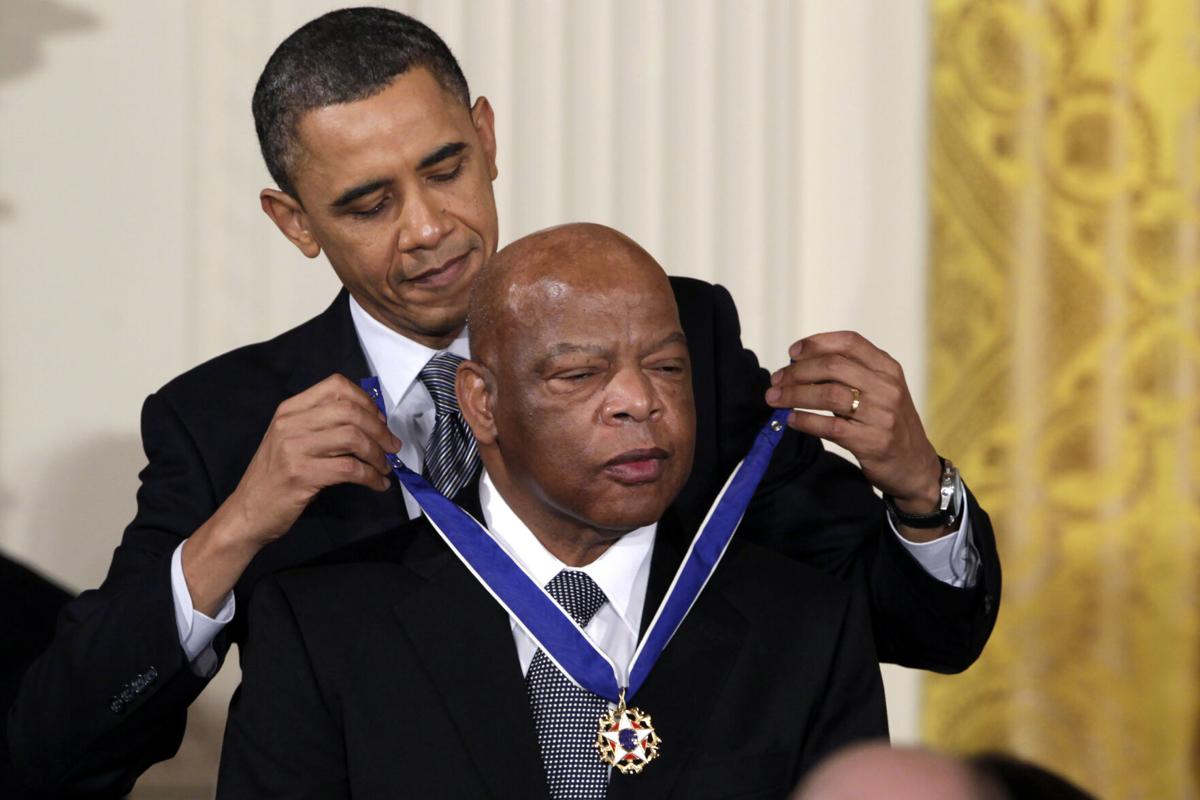
Letter #165 to friends et familiares: Good bye, John Lewis

“Do I not destroy my enemies when I make them my friends?”
-- Abraham Lincoln 

“If you can’t fly then run, if you can’t run then walk, if you can’t walk then crawl, but whatever you do you have to keep moving forward.”
-- Martin Luther King, Jr

John Robert Lewis never commanded my attention during his life-time. Yes, I admired what he said. But John Lewis was short, plain, quiet, and Black. My unreflective judgements never mattered to John Lewis or anybody else. 

So, who lost with such unthinking prejudice? 

Representative Lewis's pilgrimage from preaching to chickens as a toddler, to surviving Bloody Sunday in 1965, and on to triumphing in later life made an average man a great American. That greatness lay not in John Lewis alone, but in others, too.

In a fitting funeral yesterday, the nation celebrated that greatness and tasted the ingredients of John Lewis's "secret sauce":

  • consideration reflexive enough to care; 
  • faith tough enough to persevere; 
  • humility profound enough to forgive;
  • love rich enough to find the good in others; as well as,
  • courage gritty enough to pursue righteousness.
Two presidents did not attend that funeral -- one frail in body, the other failed in spirit. The absence of the latter eased the bereavement, sharpened the moment, and reminded us of the peril of being small-minded. That President's absence, ironically, started our renewal.

Representative Lewis laid the foundation of that renewal by showing us that, notwithstanding the accidents of birth or measures of ability, the questions -- the big questions -- in our lives remain simple and apparent to us all.

Obama to deliver eulogy for civil rights icon John Lewis in ...

The answers, too, are evident, if crushing. We saw, in the men and women who spoke yesterday at the funeral of John Lewis, leaders who had made mistakes, big mistakes. Bitterness, sacrifice, and imposed penance had followed those miscalculations. 

Representative Lewis's undefinable grace, an irreducible content of character, left him no alternative but to find the good, along with its possibilities, in those leaders. In that charity lay the way through those crushing answers, not for Presidents but for us. 

By John Lewis noticing the best in those leaders who spoke yesterday, they could see the best in us. Accordingly, this simple man, with his simple grace, not only reminded us of what American greatness should be, but also made most of us a little greater, too. 

Monday, July 20, 2020

Letter #164 to friends and familiares: CHINA

"We, of course, are saddened indeed by the events in Indochina. But these events, tragic as they are, portend neither the end of the world nor of America's leadership in the world . . . We can and we should help others to help themselves. But the fate of responsible men and women everywhere, in the final decision, rests in their own hands, not in ours."
-- President Gerald Ford, Tulane University, April 1975
"At what point then is the approach of danger [of the collapse of the Republic] to be expected [from an outside invader]? . . .  If destruction be our lot, we must ourselves be its author and finisher. As a nation of freemen, we must live through all time, or die by suicide.”
-- President Abraham Lincoln, Springfield (IL) Lyceum, 1838

B.L.U.F. (bottom-line, up front): time for a great power switcheroo between the United States and China.

INTRODUCTION
This paper does not analyse the state of the contentious rivalry between the U.S. and China. The essay reviews the current American-Chinese relationship and the state of play for the United States herself, reflecting themes in the popular press. The balance of the essay suggests a new foreign policy for the United States and her allies toward China.

OVERVIEW
As a Yank, I have to say that it is time for us to admit that the American Century is over. The United States is insolvent; debt levels in all borrowing sectors imply an eight-to-fourteen year payback. To achieve re-payment in eight years, all social programmes would be zeroed out and taxes high. Being the world’s sole super-power has led to a loss of the deep reservoir of goodwill built up by American missionaries and aid societies over the first 175 years of the Republic.

ln actuality, we are ten or fifteen years into the Chinese Century. Chinese economic growth rates have been the envy of the whole world for decades. This mighty expansion has also come at a shameful cost of:
  • Tiananmen Square;
  • Hong Kong;
  • misappropriation of technologies and industrial secrets;
  • widespread repression;
  • deepening corruption sustained by zombie financial institutions;
  • dubious data released on national health and other statitsics;
  • aggressive claims in the South China Sea;
  • aggression toward a democratic neighbour (i.e., India);
  • neo-colonialist development policies, etc.
Secondary sources (e.g., The Economist and Foreign Policy) have documented these draw-backs. Nonetheless, Chinese dominance and influence continues to expand, with mega-currency swaps carving out pockets of the renminbi being the store value currency with the rapidly developing nations (e.g., Brazil and Argentina). 
According to the Central Intelligence Agency, after rendering the yuan equal in purchasing power to the dollar, China’s adjusted G.D.P. is already 25% higher than that of the United StatesMeanwhile, back in the States, the coronavirus contagion has brought out into bold relief the impoverishment of American middle classes over the past forty years amplified by a deepening inequality between the races. Simply said, it is time for the American Republic to:
  • detach from the crushing expense of global dominance;
  • reform trade policies to re-tool to the extent that comparative advantages permit;
  • rebuild the educational system, especially for under-privileged children; as well as,
  • reverse the declining health profile, through attrition of benefits and addiction to opioids, of the nation over the previous half-century.
FOREIGN POLICY POST-AMERICAN CENTURY
My (quixotic) recommendations for consideration in the face of the loss of American power vis à vis China? Make a virtue of necessity by high profile initiatives including, but not limited to, the following:
  • hand off the global hegemon / policeman function to China, as the U.K. did to the U.S.A. in 1945;
  • in contrast to the discretion exercised at Potsdam, seventy-five years ago, by British Prime Minister Attlee and Foreign Secretary Bevin, announce the hand-off publicly;
  • in that announcement, openly welcome China's leadership in her century and count on her as the guarantor of peace in much the same way the U.S., the U.K., JAPAN, the E.U., Australia, SOUTH KOREA, Canada, New Zealand, TAIWAN, INDIA, South Africa, et al. have for many years;
  • work quietly with these sister democracies to strengthen the W.T.O., the United Nations, U.N.E.S.C.O. et al.;
  • pronounce what the U.S. and her sister democracies stand for by "appreciating" China's continuing ‘commitment’ to honour the common values in the current world order; as well as,
  • scale back U.S. war-building efforts due to the country's insolvency and stake out -- with our allies -- key interests, including the South China Sea, FORMOSA, the Persian Gulf, etc.
These ideas sound cowardly to those of us used to equating American exceptionalism with military power. American exceptionalism is real and was never about the power of weapons but of ideas; that exceptionalism ceased being unique generations ago. Fellow democracies and other nations aspiring to popular governance across the world share that exceptionalism today.

RATIONALE
(i.e., best-case outcome)
These ('out-there') ideas may confer upon the many nations alarmed by the excesses of Peking, consistently enumerated by the popular press, certain advantages.
  1. Such a dramatic shift will force China rapidly to clarify her intentions about her role.
  2. As the global cop stalking the street, China will be so bizzy that imperial aggression should become more difficult to pursue.
  3. With no more bickering about who is number-one among the democracies or the degree of asserted primacy of American interests, the U.S. can get on with her business as a stalwart supporter of human rights and republican governance, along with dozens of other nations.
  4. By crowning China as the 'king of the mountain', avenues of secondary attack open up easing and empowering the ability of N.A.T.O., Japan, Australia, South Korea et al. to chip away at China’s geo-political position and dissipate her power incrementally.
  5. As China eventually faces collapse -- as has the U.S. after more than a generation of being a 'hyper-power' -- strengthened international institutions rather than contentious nation states will be better positioned to mend the breach.


Tuesday, July 7, 2020

Letter-162 to Friends et Familiares: Race in America -- ¿Reckoning & Reconciliation?

A view of Black Lives Matter by an ageing White Conservative

NOTE: all embedded links indicated by bold green-font italics.

“’Racialism’ is racism with a triple-digit I.Q.”          -- Anonymous

« Qu’est-ce-que c’est un symbole phallus encore? »
« It’s your dick, idiot!”
“Oh . . . oops.”

-- A Midwestern Republican high schooler (i.e., me) in French Literature class discussing the poetry of Aimé Césaire, October 1974
  “Of course, all lives matter. Right now, Black lives matter a bit more.”
 -- Anonymous
Update as at 04mar24: as a control for the calculation of reparations -- stated as $10.3 TRILLION (roughly $12.6 TRILLION, inflation adjusted since July 2020) below -- I applied a weighted average of current hourly wages for four occupations construction workers, farm workers, domestic servants, and tradesman to an estimated 410 billion labor hours performed by slaves from 1619 to 1861. At an estimated average wage of $18.19, that reparations figure falls to $7.8 TRILLION, some 30% lower than the estimate stated below. I stand by the higher estimate as more comprehensive through scenario-testing based upon wealth rather than wages only.

B.L.U.F. (bottom-line, up-front). the protests following the murders of Breonna Taylor and George Floyd are at an inflection point: failure through justifying violence for short-term gains versus the hard work toward success over the next two generations.

INTRODUCTION.
As I remain a conservative by nature, current reports of looting and destruction of small businesses unsettle me, deeply. “Conservative by nature” means that my politics are centre-right and, more importantly, I tend toward prudence, probabilities, contingencies, and exit ramps. The United States has already failed twice to attain a full racial reconciliation and equality by setting things right for African Americans; hopefully, this third time will be our charm.

THE CURRENT STATE of FRAY
We live in the midst of a full-blown Black rebellion, one that is overdue. Hispanics, many Asian Americans and Muslims, as well as, for now, sympathetic Whites support this uprising following the police murders of George Floyd, pre-meditated, in Minneapolis six weeks ago and of Breonna Taylor, reckless, in Louisville before that. Ironically, the white supremacists and the gangster régime that coddles them also spark the impetus of the Black Lives Matter (i.e., B.L.M.) movement to act.

America is not in danger of B.L.M.-inspired anarchy, or facing a Trump-instigated reign of terror. Nevertheless, for the B.L.M.-led revolution to succeed, it will need to sustain the stalwart support of at least forty per cent of American Whites. That support will need to remain steadfast not only for today or tomorrow. Not just this week, month, year or even this decade. White support will have to continue for two generations — the time required to change a culture.

WHAT the BLACK REBELLION REALLY MEANS.
First, this rebellion will not degenerate into a race war since the economic disparity fuelling this resistance involves class as much as race. Many Whites now share the same economic interests as Blacks in the B.L.M. movement. Most other Whites outside of Black Lives Matter remain sufficiently decent not to force their Black brethren into a corner thus precipitating an existential struggle for survival.


While elements of the protest display some of the street politics of traditional anarchy, this movement does not yet impress me as an enduring concoction of socialism and anarchy led by a violent vanguard to usher in an illusory peace never realised. The principal elements catalysing and sustaining the B.L.M. movement appear to be:
  • autonomy assumed by more Blacks to reach a cultural and economic self-reliance for and by all African Americans;
  • an energetic push for justice  for Blacks — meaning justice in fact, life, law, and system — too long deferred and, therefore, denied; as well as,
  • final realisation of reparations due to the descendants of enslaved Black Americans to recover not only the value of labour stolen during 250 years of involuntary servitude, but also by 150 years systematic under-valuation of said labour.
SELF-RELIANCE.
Louis Farrakhan, the divisive leader of the Nation of Islam in the United States, the religious group known as the Black Muslims, remains a mystery to me. From what I have heard about him, the man strikes me as dangerous and prone to violence. Yet, in his long and discursive speech at “The Million Man March” a quarter of a century ago, Mr Farrakhan said one thing that has stuck with me all these years as absolutely valid: that Whites can not care enough for Blacks voluntarily to lift them into freedom in equality.

This call to self-reliance represents the long-term phase of the B.L.M. movement. Why would Moses march the Hebrews through a desert for forty long years in The Book of Shemot (a / k / a The Exodus)? To wean the newly liberated slaves from the Pharaoh’s certain but hard-earned lentils and grow into a culture of individual virtue and innovation. That required forty years, or two generations.

The long-term commitment contemplated here applies not only to Blacks and a critical mass of Whites, but also to Muslims as well as to Asian, Native and Spanish Americans. This long march of progress will be every bit as taxing and liberating for all Americans as it was for the Exodus or the Great Civil War from 1861–65 by:
  • breaking the chains of an underclass, the enculturated dependency of which systematically deprives millions of Black men and women from assuming their properly ordained statures in the eyes of G-D;
  • Blacks setting an example of the de-segregation of the heart and the hard work of breaking a cyclical culture of violence as defined by a scourge of Black-on-Black crime attendant to easy guns and drugs quietly condoned by too many Whites as “not our problem”; as well as, somehow,
  • cultivating the renewal of the nuclear family and an emphasis on meaningfully provisioned education across African Americana.
Along with millions of other fellow Americans, I have my ideas on how the larger society should redress these systemic shortcomings of our culture and political economy. All such ideas, save one, lie beyond the scope of this essay; the one exception being that every White, beginning with me, needs to embrace these challenges as ‘our’ problem, not ‘their’ problem. Shrugging my shoulders in indifference becomes complicity with white supremacists.

These practitioners of ‘eliminationist racism’ comprise the number-one terror threat within the United States according to the F.B.I. In short, for Whites to place sole responsibility of remedial action and initiative onto Blacks is to blame the victim. More resources for programmes in place are not enough; affirmative action alone was not enough. To reach a just society requires de-segregation of the heart, or a concerted commitment of will by each and every American. To do what? Not necessarily never to feel racism, but never to act on, or give voice to, that racism when it arises within each of us.

RE-MASCULATION of BLACK MEN
My thinking here comes from studying the Black revolutionary poetry of Aimé Césaire in a French Literature course in high school and my later reading of The Wretched of the Earth by Frantz Fanon. The take-away from these two writers is the necessity of violence for the reprise of Black male autonomy. Obviously, this kinetic road to one’s re-humanisation has its pitfalls.


Most delicate of these tensions remains the fact that many or most Americans in general, and Whites in particular, take a dim view of looting and what looks like wanton property damage and vandalism unrelated to the struggle for justice itself. There may be more latitude toward pulling down monuments or torching unoccupied police cars. These are common enough objects and replaceable, after all.

Nevertheless, busting up people’s shops and ruining their livelihoods, though almost certainly less frequent than anti-B.L.M. partisans assert, does not play well in the suburbs quickly wearing down the formidable and sustained level of commitment required of Whites (i.e., 40% for two generations). More Whites may acquiesce to looking the other way on police violence against Blacks in the face of such gratuitous violence, thus undermining the painful process of racial reparations and national conciliation.
In another respect, however, limited and highly visible destruction can catalyse the Black rebellion to sustain radical change and impress the message of that rebellion upon Whites. As Lawrence of Arabia noted that, for people in revolutionary ferment, looting often is less about opportunistic plunder and more an agitprop to confirm and inspire the bottom-up repudiation of a corrupted, unjust régime.

And, American Blacks have suffered long and hard under an unjust order. The question now arises, from my conservative world-view, of when to stop the current violence; indeed, anecdotally, the violence appears to be abating and its extent is overplayed. That is: ¿how close is the current street crime to the invisible line before it flashes red to less sympathetic Whites? Put simply: ¿when is enough, enough?

The brittle balance required to maintain the pro-B.L.M. coalition prescribes a switching point from violent to non-violent resistance. For me, at least, the protestors are fast approaching that limit. Now would be the ideal time for many repeats of what occurred in Louisville when protestors protected a policeman surrounded by a volatile mob.

B.L.M. participants may not be able to prevent looting or vandalism, but they can photograph or film the people leading it and report the looting to police. As the police arrive to the area B.L.M. coordinators then open a lane of approach for the police through the protestors. Above all, the great majority of protestors must practice zero-tolerance for the taking of any life, including those of policemen. Coöperation with police will more likely consolidate the necessary support among Whites of goodwill.

In the meantime, law enforcement needs to stop battering reporters and other innocents. Instead, police and crime detection professionals should investigate who is actually committing these crimes. Descriptions of recent ‘Anti-fa terrorists’ depict people whose behaviours correspond more closely with those of white supremacists (i.e., the number-one domestic source of terror per F.B.I. Director Wray).


THE CHALLENGE of REPARATIONS. 
If one is oblivious to history, as I was for many years when I was complaisant with my own racism, (s)he will likely dismiss the whole notion of Black reparations as reverse discrimination conferred upon Blacks for doing nothing. This dismissal is at best false and most likely racist. Reparations seek to restore to the descendants of slaves the value of the labour looted from their ancestors during 250 years of involuntary servitude.

In fact, additional largesse may well be in order to recover the amount of labour not fairly compensated during days of debtor prisons, share-cropping, Jim Crow laws, segregation, and a near-universal discrimination against African Americans. While affirmative action and civil rights laws have addressed these issues, segregation remains deeply entrenched; moreover, since 2013, numerous states have been undermining voting rights for Blacks and voting-age students, two core segments of B.L.M. and, coincidentally, segments of the population not known for an affinity toward the Republican Party as it now stands.
President Grant tried to monetise reparations for slaves in the 1870s but failed. A hundred years later, President Johnson made as strong an effort as President Grant had with the Voting Rights Act, the Civil Rights Act, the Fair Housing Act as well as programmes including Model Cities and Affirmative Action. The current round of demands for reparations indicates that, fifty years later, one can see that the Great Society has also failed. Both efforts tried hard enough, but not long enough.

Reparations calculations vary widely due to the sensitivities of assumptions and values assigned to parameters. The redemption value of Dr King’s defaulted promissory note ranges from $500 billion to four trillion dollars on the lower end all the way up to fourteen trillion dollars on the higher end; values seem to settle in the $10–12 TRILLION range. My particular calculations integrate the following five scenarioes into a composite reparations bill of $10,865,616,290,109:
  1. best case based on full and fair value of labour starting with the boom after the Civil War;
  2. worst case of permanently depressed agricultural economies but full and fair employment;
  3. the odious price of each slave in 1860 restated in today’s dollars;
  4. the historical valuation of forty acres and a mule in 1869 re-stated in today’s dollars; as well as, 
  5. earnings power from an up-dated version of forty acres and a mule (e.g., small tractor).
There is the question of costs of affirmative action of $590+ billion and cumulative losses from race riots, conservatively estimated at $10 billion by assuming a $2 billion worst case for the George Floyd protests. These total, conservatively, $600,394,566,141. Deducted from the gross bill of reparations, the net payable due to Blacks is $10,265,221,723,968.

CONCLUSION.
Victor Hugo observed that nothing is so powerful as an idea whose time has come. To realise that idea in the case of Black Lives Matter, however, one must recall and heed Ralph Waldo Emerson and Louis Farrakhan that envy is ignorance, imitation suicide. These thoughts delineate the opportunity and dilemma facing the Black Lives Matter movement.

Indeed, realisation through beneficial use of the $10.3 TRILLION net reparations bill, if collected, rests on profound changes with the hearts of Blacks and Whites alike:
  • switching to non-violent resistance as exemplary citizens;
  • restoring the full and just esteem of Black men and Black families;
  • educational opportunities for Black children renewed; and,
  • the final strides toward freedom taken by Whites intent upon, and with a steadfast patience toward, a new and better America.